
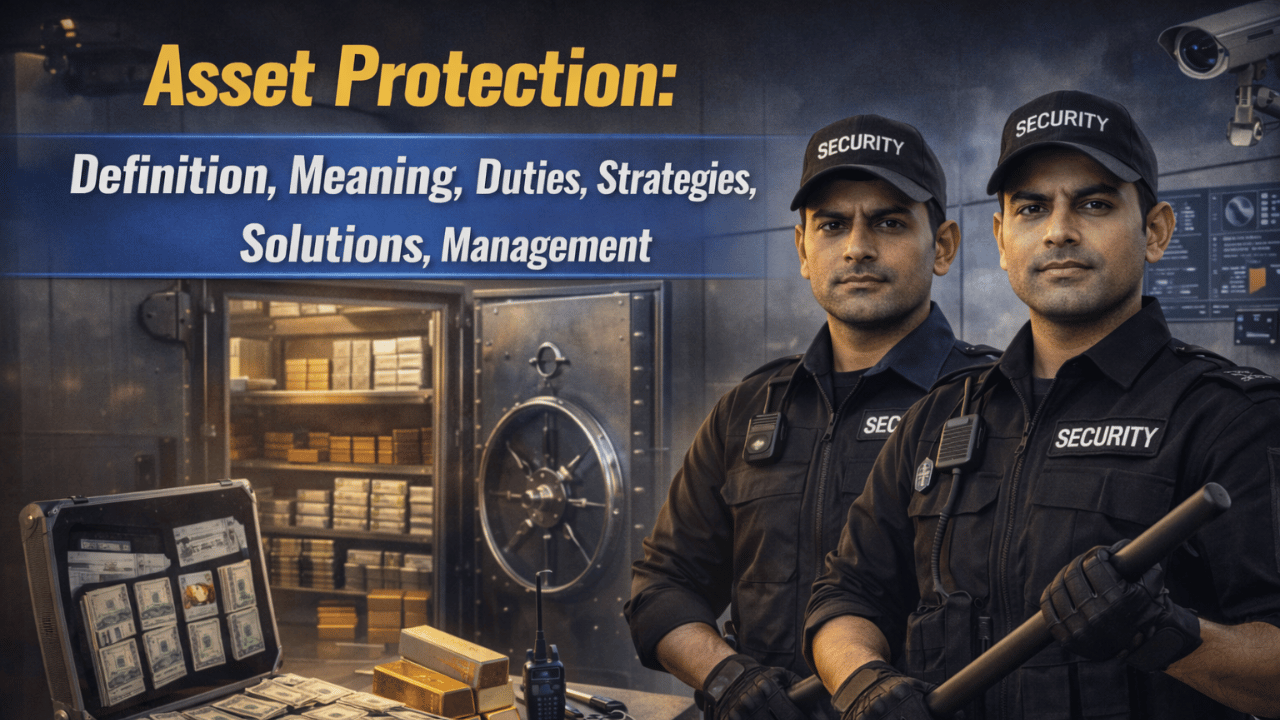
Asset Protection: Definition, Meaning, Duties, Strategies, Solutions, Management

Asset protection encompasses the security measures, strategies, and trained personnel deployed to safeguard physical property, intellectual property, and digital assets from theft, fraud, and damage. Research on the role of asset protection in corporate security demonstrates how comprehensive protection strategies directly contribute to minimising financial losses and preventing security breaches. Asset protection security guards serve as the frontline defence, conducting surveillance monitoring, investigating theft, implementing fraud prevention protocols, and responding to security incidents across retail, corporate, industrial, and construction environments.
Asset protection security combines physical security measures including surveillance systems and access control with loss prevention strategies, risk assessment processes, and crisis management capabilities. Security providers deliver customised security solutions incorporating mobile patrol services, static guards, and advanced surveillance technology to address specific asset protection requirements. Effective asset protection minimises financial losses while ensuring compliance with security protocols and maintaining employee safety throughout protected premises.
This comprehensive guide examines asset protection duties, strategies, solutions, and management practices for Melbourne businesses. Property managers, retail operators, and corporate security professionals will gain practical knowledge for implementing effective asset protection systems that reduce shrinkage, prevent theft and fraud, and protect valuable business resources.
What Is Asset Protection in Security Services?
Asset protection in security services refers to the comprehensive strategies and measures implemented to safeguard business assets from theft, fraud, damage, and unauthorised access. This critical security discipline protects the full spectrum of organisational assets including physical property, intellectual property, and digital resources. Asset protection associates and security guards work within structured programs that combine human surveillance, technology systems, and procedural controls to minimise losses and maintain asset integrity.
The importance of asset protection extends across all business sectors where valuable resources require protection. Retail environments face shrinkage from shoplifting and employee theft. Corporate facilities protect sensitive information and expensive equipment. Industrial sites safeguard machinery, materials, and infrastructure. Construction projects secure tools, plant, and building materials from theft and vandalism. Effective asset protection addresses these diverse requirements through tailored security solutions.
What Does Asset Protection Mean in the Context of Business Security?
Asset protection in business security means implementing systematic measures to identify, protect, and preserve valuable business resources from loss, theft, damage, or misuse. This encompasses proactive strategies that prevent losses before they occur alongside reactive capabilities that respond to incidents and minimise impact. Asset protection programs integrate security personnel, technology systems, policies, and procedures into cohesive frameworks addressing identified risks.
Business asset protection operates as both a security function and a business management discipline. Security aspects focus on theft deterrence, surveillance, and incident response. Management aspects address inventory control, loss analysis, procedural compliance, and continuous improvement. This dual focus ensures asset protection delivers measurable business value through reduced losses and improved operational efficiency.
What Are the Different Types of Assets That Need Protection?
Physical assets requiring protection include tangible property such as buildings, equipment, inventory, vehicles, and infrastructure. Retail merchandise, manufacturing equipment, construction plant, and office technology all represent physical assets vulnerable to theft, damage, or misuse. Physical asset protection employs guards, surveillance systems, access controls, and secure storage to prevent unauthorised removal or damage.
Intellectual property encompasses patents, trademarks, trade secrets, designs, and proprietary processes that provide a competitive advantage. Protecting intellectual property requires controlling access to sensitive information, monitoring for unauthorised disclosure, and securing documents and data containing proprietary content. Research on digital asset protection and cybersecurity solutions highlights tools including encryption, access controls, and monitoring systems that secure digital resources.
Digital assets include software, databases, cloud-based resources, and electronic records essential to business operations. Data protection measures secure digital assets against unauthorised access, theft, corruption, and loss. While cybersecurity addresses technical protections, physical security guards contribute by controlling access to data centres, server rooms, and workstations where digital assets are stored and accessed.
How Is Asset Protection Different From Other Forms of Security?
Asset protection differs from general security in its specific focus on preventing and detecting loss rather than on broader premises protection. While general security guards may focus on access control, perimeter security, and emergency response, asset protection specialists concentrate on theft prevention, fraud detection, inventory control, and shrinkage reduction. This specialised focus requires additional training in loss-prevention techniques, investigative methods, and retail operations.
Asset protection also differs through its integration with business operations and performance measurement. Asset protection programs track shrinkage rates, recovery values, and loss prevention effectiveness using metrics that demonstrate business impact. This data-driven approach enables continuous improvement and justifies security investment through documented loss reduction. General security services may lack this operational integration and performance focus.
Duties of Asset Protection Security Guards
Asset protection security guards perform specialised duties focused on preventing theft, detecting fraud, and minimising losses across protected environments. Their primary role involves safeguarding assets, merchandise, and resources through surveillance, investigation, and intervention. Core responsibilities span patrolling premises, monitoring surveillance systems, conducting risk assessments, responding to security incidents, and maintaining detailed security logs that support loss analysis and continuous improvement.
What Are the Core Responsibilities of an Asset Protection Guard in Different Industries?
Retail asset protection guards focus on preventing shoplifting, detecting employee theft, and controlling shrinkage through visible presence and covert surveillance. Research on loss prevention in retail identifies best practices covering employee theft, shoplifting prevention, and inventory control that guide retail asset protection operations. Guards monitor customer behaviour, observe staff activities, and intervene when theft indicators emerge.
Corporate asset protection guards protect office equipment, sensitive documents, and intellectual property through access control and surveillance. Guards verify credentials, monitor visitor access, and ensure compliance with security protocols protecting valuable information. Industrial asset protection addresses machinery, inventory, and infrastructure security through patrol coverage, alarm response, and access management.
Construction site asset protection guards protect tools, plant, materials, and partially completed works from theft and vandalism. Guards control site access, verify contractor credentials, conduct equipment checks, and maintain overnight surveillance when sites are unoccupied. Each industry context requires adapted approaches while maintaining core asset protection principles.
How Do Asset Protection Guards Detect and Prevent Theft or Fraud?
Asset protection guards detect theft through trained observation of behaviour patterns indicating criminal intent. Guards watch for concealment actions, nervous attention to security positions, unusual merchandise selection, and other behavioural indicators identified through loss prevention training. CCTV monitoring extends observation capabilities, enabling guards to track suspicious individuals across large areas and capture evidence of theft activity.
Prevention strategies combine visible deterrence with covert surveillance that catches offenders who proceed despite uniformed presence. Guards positioned at exits conduct bag checks and receipt verification. Patrol routes cover high-theft areas including stockrooms, loading docks, and high-value merchandise locations. Fraud detection involves monitoring transactions, identifying suspicious patterns, and investigating discrepancies revealed through inventory audits or exception reporting.
Investigation capabilities enable guards to gather evidence supporting apprehension and prosecution. Guards document observations, preserve physical evidence, coordinate with management, and liaise with police when criminal charges proceed. Thorough investigation and documentation increase prosecution success rates while deterring future offending.
What Role Do Asset Protection Guards Play in Crisis Management and Emergency Response?
Asset protection guards contribute to crisis management through rapid response to security breaches, theft in progress, and emergency situations threatening assets or personnel. Guards follow established emergency response protocols that prioritise safety while protecting business interests. Training prepares guards to handle scenarios including active threats, natural disasters, fires, and medical emergencies.
Emergency response planning defines guard roles during crisis situations. Guards may secure valuable assets, assist with evacuations, provide first aid, coordinate with emergency services, or maintain perimeter security. Post-incident responsibilities include scene preservation, evidence documentation, witness identification, and detailed reporting that supports investigation and recovery efforts.
Crisis management extends to business continuity protection during disruptions. Guards secure premises during power outages, system failures, or other events that create vulnerability windows. Coordination with law enforcement ensures appropriate response escalation when incidents exceed internal capabilities.
Common Strategies and Solutions for Asset Protection
Effective asset protection employs multiple strategies and solutions working together to create comprehensive protection systems. Research on the impact of technology on asset protection highlights the role of CCTV, body-worn cameras, and surveillance systems in modern protection programs. Businesses combine technology integration, physical security measures, staff training, and procedural controls to address identified asset risks.
What Are the Most Common Asset Protection Strategies Used by Businesses?
Surveillance systems form the foundation of most asset protection programs. CCTV cameras provide continuous monitoring and evidence recording. Body-worn cameras document guard interactions and incidents. Access control systems restrict entry to authorised personnel while creating audit trails of movements. Alarm systems detect breaches and trigger response protocols.
Risk management systems identify vulnerabilities and track loss patterns. Regular audits verify inventory accuracy and identify shrinkage sources. Exception reporting from point-of-sale systems flags suspicious transactions for investigation. Loss analysis identifies trends enabling targeted intervention. These systems provide data supporting resource allocation and strategy refinement.
Physical security measures create barriers to theft and unauthorised access. Security fencing, barriers, and gates control site access. Secure storage protects high-value items. Lighting deters criminal activity while supporting surveillance effectiveness. Staff training ensures employees recognise suspicious activity and follow security protocols. Combined strategies create layered protection addressing multiple threat vectors.
How Do Surveillance Systems and Monitoring Technologies Contribute to Asset Protection?
Surveillance systems contribute to asset protection through deterrence, detection, and evidence capabilities. Visible cameras deter theft by signalling active monitoring. Camera coverage extends observation beyond guard capacity, enabling monitoring of multiple areas simultaneously. High-resolution recording captures evidence supporting the identification, investigation, and prosecution of offenders.
Advanced monitoring technologies enhance surveillance effectiveness through automation and analytics. AI-driven monitoring identifies suspicious behaviour patterns, triggering alerts for guard response. Video analytics detect specific events such as perimeter breaches, loitering, or object removal. Real-time GPS tracking monitors mobile assets and patrol vehicles. These technologies multiply guard effectiveness while providing continuous coverage.
Integration between surveillance systems and other security elements creates comprehensive protection. Access control integration links entry events with video footage. Alarm integration triggers camera recording and guard dispatch. Communication tools enable rapid coordination between monitoring centres and on-site personnel. Integrated systems provide cohesive protection rather than isolated security elements.
What Are the Legal Considerations When Implementing Asset Protection Strategies?
Asset protection implementation must comply with privacy laws governing surveillance and monitoring. Melbourne’s Security Licensing Act 2004 establishes the legal framework for asset protection services and security officer licensing. Surveillance must respect privacy expectations while meeting security objectives. Signage notifying persons of camera monitoring typically satisfies legal requirements for most commercial environments.
Guard powers and limitations require careful understanding to ensure lawful operations. Detention of suspected thieves must follow the citizen’s arrest requirements, including witnessing offences and using reasonable force only. Search powers are limited to consent-based bag checks or requests to leave premises. Evidence handling must preserve chain of custody for court admissibility. Training ensures guards operate within legal boundaries.
Employment law considerations affect internal investigations and employee monitoring. Staff surveillance must comply with workplace laws and employment contracts. Investigation procedures must respect employee rights while protecting business interests. Legal advice guides implementation of asset protection measures affecting employees.
Best Practices for Asset Protection Management
Asset protection management coordinates security personnel, technology systems, policies, and procedures into effective programs that safeguard business assets while enabling operational efficiency. Best practices ensure programs address identified risks, comply with legal requirements, and deliver measurable loss reduction.
What Are the Key Elements of an Effective Asset Protection Management System?
Effective asset protection management systems incorporate regular risk assessments that identify potential threats and address vulnerabilities before losses occur. Assessments examine physical security, procedural controls, technology systems, and personnel practices. Identified gaps receive prioritised remediation based on risk severity and loss potential.
Staff training and development ensure security personnel maintain current knowledge and skills. Training covers loss prevention techniques, technology operation, legal requirements, and customer service. Ongoing development addresses emerging threats, new technologies, and lessons learned from incidents. Competent personnel form the foundation of effective asset protection.
Compliance with laws and regulations protects businesses from legal exposure while ensuring ethical operations. Security licensing, privacy requirements, employment laws, and industry standards all require attention. Technology adoption accelerates protection capabilities through automation, AI, and advanced monitoring tools. Effective management integrates these elements into cohesive programs delivering consistent results.
How Can Businesses Integrate Asset Protection With Broader Organisational Security Strategies?
Asset protection integration with broader security strategies ensures coordinated protection addressing all organisational risks. Physical security, cybersecurity, personnel security, and business continuity functions should align through unified risk management frameworks. Shared threat intelligence enables comprehensive response to complex risks spanning multiple security domains.
Organisational structure should support integration through clear reporting lines and communication channels. Asset protection managers coordinate with facilities management, IT security, human resources, and operations to address cross-functional risks. Regular security committee meetings align priorities and resolve coordination challenges. Integrated systems share data enabling holistic situational awareness.
Security policies should establish consistent standards across all protection functions. Incident response procedures integrate asset protection with emergency management and business continuity. Training programs address both function-specific and enterprise-wide security requirements. Integration maximises protection value while optimising security investment efficiency.
What Are the Challenges in Managing Asset Protection and How Can They Be Overcome?
Common asset protection challenges include balancing security with customer experience, managing costs while maintaining effectiveness, and adapting to evolving threats. Excessive security measures may deter legitimate customers or impede operations. Cost constraints limit technology investment and staffing levels. Criminal methods continuously evolve, requiring ongoing adaptation.
Overcoming these challenges requires data-driven decision-making that justifies security investment through documented loss reduction. Customer-friendly approaches maintain protection effectiveness while preserving positive experiences. Technology leverage extends guard capabilities without proportional cost increases. Threat intelligence and industry collaboration identify emerging risks enabling proactive response.
Continuous improvement processes refine programs based on performance analysis and incident review. Regular assessment identifies what works effectively and what requires adjustment. Benchmarking against industry standards reveals improvement opportunities. Professional security partnerships provide expertise and resources supporting program enhancement.
Asset Protection Services Offered by Walton Security
Walton Security delivers comprehensive asset protection services across Melbourne and Melbourne, providing customised solutions that address specific client requirements while meeting industry standards for professional security delivery.
How Does Walton Security Tailor Its Asset Protection Services to Different Industries?
Walton Security tailors asset protection services through industry-specific expertise and customised program development. Retail clients receive guards trained in loss prevention techniques, customer service, and shoplifter apprehension. Corporate clients benefit from guards skilled in access control, confidential information protection, and professional visitor management. Industrial clients access guards experienced in equipment security, site access control, and hazardous environment protocols.
Service customisation begins with comprehensive risk assessment examining client assets, threats, vulnerabilities, and operational requirements. Assessment findings inform guard deployment, technology recommendations, and procedural development. Ongoing program management adjusts services based on performance analysis and changing client needs.
What Makes Walton Security's Asset Protection Solutions Unique in Melbourne?
Walton Security’s asset protection solutions combine licensed guards, advanced surveillance technology, and comprehensive support services. On-site asset protection provides licensed guards for retail, corporate, and industrial properties. CCTV monitoring and remote surveillance extend coverage beyond guard presence. Consulting and training services help clients implement effective internal protection measures.
Emergency response services provide rapid intervention when theft or breaches occur. 24/7 control room operations coordinate guard deployment and incident response. Detailed reporting demonstrates program effectiveness and supports continuous improvement. Local Melbourne and Melbourne expertise ensures understanding of regional requirements and rapid response capabilities. Contact Walton Security for a consultation to discuss your asset protection requirements.
Legal Requirements and Licensing for Asset Protection in Melbourne
Asset protection services in Melbourne operate under regulatory frameworks established by Melbourne’s Security Licensing Act 2004 and related regulations. Understanding legal requirements ensures compliance while protecting businesses from liability exposure associated with unlicensed security provision.
Overview of the Private Security Act 2004 and Asset Protection Licences
The Private Security Act 2004 establishes licensing requirements for security personnel performing asset protection functions in Melbourne. Guards must hold valid security licences issued by Melbourne Police Licensing and Regulation Division. Licence applications require national criminal history checks, character assessment, and evidence of completed training. Security companies must hold master licences authorising provision of security services.
Asset protection activities including surveillance, patrol, access control, and loss prevention fall within licensed security functions. Guards must wear visible identification displaying licence details. Employers bear responsibility for verifying guard credentials and maintaining compliance documentation. Using licensed providers protects businesses from penalties associated with engaging unlicensed security.
Training, Competency, and Ongoing Obligations for Asset Protection Guards
Asset protection guards require Certificate II in Security Operations as minimum qualification, covering core competencies including communication, conflict management, legal powers, and emergency response. First aid certification enables response to medical incidents. Additional training in loss prevention techniques, investigation methods, and retail operations enhances asset protection effectiveness.
Ongoing obligations require guards to maintain current licensing through five-yearly renewals with updated background checks. Professional development maintains skill currency and addresses emerging challenges. Compliance obligations include accurate incident reporting, proper identification display, and behaviour standards reflecting industry professionalism. Choosing licensed providers like Walton Security ensures full compliance with Melbourne requirements.
Measuring Asset Protection Effectiveness and ROI
Asset protection effectiveness requires measurement through metrics demonstrating loss reduction, incident response, and business impact. Performance measurement supports resource allocation decisions, program refinement, and stakeholder communication about security value.
What Metrics Should Businesses Track to Measure Asset Protection Success?
Shrinkage rate represents the primary metric for asset protection effectiveness, measuring inventory loss as a percentage of sales. Comparing shrinkage rates before and after program implementation demonstrates protection impact. Tracking shrinkage by department, category, and time period identifies problem areas requiring attention.
Incident metrics capture apprehensions, recoveries, deterred theft attempts, and response times. Recovery values quantify merchandise returned to inventory through asset protection activities. Investigation outcomes track prosecution rates and case closures. Safety metrics monitor injuries, threats, and security-related workplace incidents.
Operational metrics assess guard performance including patrol completion, checkpoint verification, and report quality. Customer feedback measures security impact on shopping experience. Employee surveys assess workplace safety perceptions. Comprehensive metrics enable balanced assessment of asset protection program performance.
How Can Businesses Calculate Return on Investment for Asset Protection Programs?
Return on investment calculation compares asset protection costs against documented loss reductions and other benefits. Security investment includes guard wages, technology systems, training, and management overhead. Loss reduction measures shrinkage decrease, recovery values, and prevented incidents. Programs delivering loss reductions exceeding security costs generate positive returns.
Additional benefits beyond direct loss reduction may include reduced insurance premiums, improved employee retention, enhanced customer confidence, and regulatory compliance value. These benefits, while harder to quantify, contribute to overall program value. Regular ROI analysis supports budget justification and identifies programs requiring adjustment to improve returns.
Frequently Asked Questions About Asset Protection
Is Asset Protection the Same as Loss Prevention?
Yes, asset protection and loss prevention are largely synonymous terms describing programs that protect business assets from theft, fraud, and shrinkage. Some organisations use asset protection as a broader term encompassing physical security, information protection, and business continuity alongside loss prevention activities. In retail contexts, the terms are often used interchangeably to describe programs preventing inventory loss.
What Is the Difference Between Asset Protection and Security Guards?
Asset protection refers to the specialised focus on preventing and detecting losses, while security guards provide broader protection services including access control, emergency response, and premises security. Asset protection guards receive additional training in loss prevention techniques, investigation methods, and retail operations. General security guards may lack this specialised knowledge while providing valuable protection for other security functions.
How Do I Know If My Business Needs Asset Protection Services?
Businesses need asset protection services when shrinkage rates exceed acceptable levels, theft incidents occur regularly, or valuable assets require protection beyond general security measures. High-value inventory, retail operations, and environments with public access typically benefit from dedicated asset protection. Risk assessment examining current losses, asset values, and threat levels determines whether asset protection investment is justified.
Are Uniformed or Plain-Clothes Asset Protection Guards More Effective?
Uniformed and plain-clothes asset protection guards serve complementary purposes with different effectiveness profiles. Uniformed guards provide visible deterrence preventing many theft attempts. Plain-clothes guards catch offenders who proceed despite visible security, particularly effective against organised crime groups. Most asset protection programs achieve optimal results through combined deployment using both visible deterrence and covert detection.
Can Asset Protection Guards Detain Suspected Shoplifters?
Yes, asset protection guards can detain suspected shoplifters under citizen’s arrest powers when they directly witness theft offences. Guards must observe merchandise selection, witness concealment, maintain continuous surveillance, and allow suspects to pass the last point of sale. Detention must be brief and proportionate, with prompt handover to police. Guards cannot search detained persons without consent.
How Should Businesses Choose an Asset Protection Provider?
Choose asset protection providers by verifying licensing compliance, assessing experience with similar businesses, evaluating guard training programs, and reviewing reporting capabilities. Request references from clients in comparable industries. Confirm 24/7 support availability and technology capabilities. Assess cultural fit and communication quality. Licensed providers with demonstrated loss prevention expertise deliver superior results compared to general security firms.
What Training Do Asset Protection Guards Receive?
Asset protection guards complete Certificate II in Security Operations covering core security competencies, plus additional training in loss prevention techniques, theft detection, investigation methods, evidence handling, and customer service. Retail-focused training addresses shoplifter behaviour patterns, apprehension procedures, and store operations. Ongoing professional development covers emerging theft methods, legal updates, and technology operations. Quality providers deliver comprehensive training exceeding minimum licensing requirements.