
Static Security Guards: Definition, Meaning, Duties
A static security guard is a licensed officer assigned to a fixed location for a set shift, with the job of watching one site rather than driving between several. In Melbourne, that usually means a guard standing at a building entrance, sitting in a gatehouse on a construction site, or working a concierge desk in a CBD office tower. The role is regulated under the Victorian Private Security Act 2004, every guard must hold a current Victorian Private Security Licence, and standard hourly rates run from around AUD $35 to $65 for daytime shifts. This guide breaks down the definition, what “static” actually means in security terms, the day-to-day duties involved, how the role differs from mobile patrols, and where these guards typically work across Melbourne and wider Victoria.
What Is a Static Security Guard?
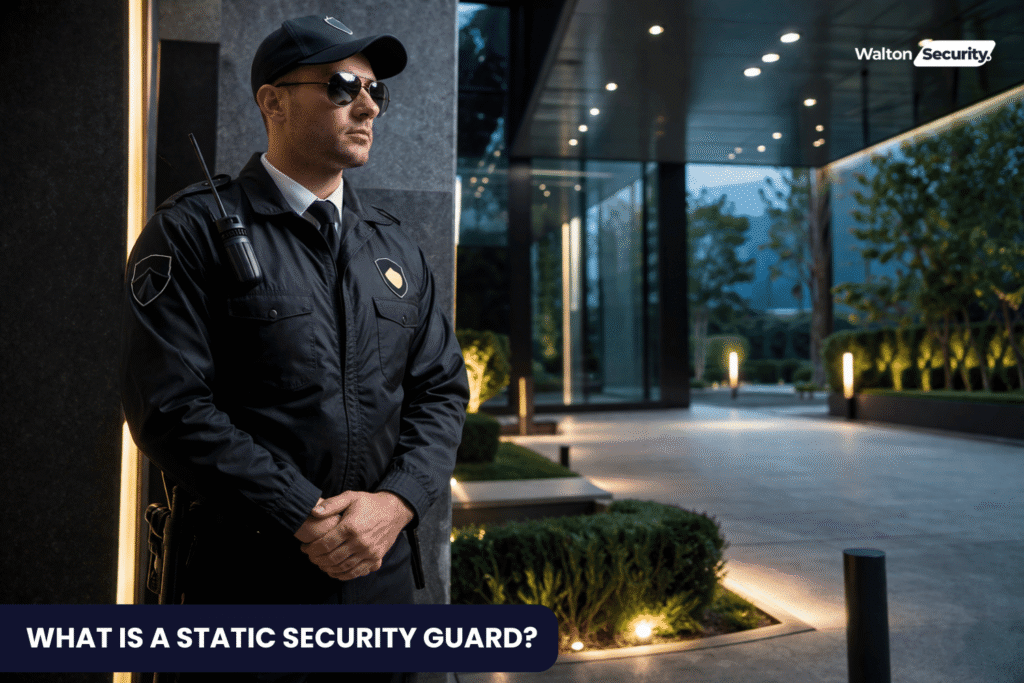
A static security guard is a uniformed, licensed security officer who is posted to a single, fixed location for the duration of their shift. The word “static” describes their position, not their activity. They aren’t standing still. They patrol within a defined site, monitor entries and exits, check visitors, watch CCTV feeds, and respond to incidents inside that one boundary.
Compare that to a mobile patrol officer, who drives between multiple sites in a single shift. Or a crowd controller, who manages people flow at licensed venues. A static guard owns one site for their hours on the clock. That’s the distinction that matters when you’re choosing a service.
In Melbourne, you’ll see static guards at construction sites in Docklands, hospital lobbies in Parkville, retail centres along Chapel Street, residential apartment buildings in Southbank, and corporate offices across the CBD. The job title sometimes changes (concierge security, gatehouse officer, retail loss prevention officer, building security guard), but the underlying role is the same: one guard, one site, one shift.
What Does “Static” Mean in Security?
The word causes confusion. People hear “static” and picture a guard standing in one spot, arms crossed, doing nothing for eight hours. That’s not the work.
In security terminology, static refers to the deployment model, not the activity level. A static guard is fixed to one site. They walk perimeters, check rooms, log entries, scan CCTV, check fire doors, talk to visitors, write incident reports, and respond when something goes wrong. The shift is busy when the site is busy and quiet when the site is quiet, but the guard is always working within the boundaries of that single property.
The opposite is “mobile” or “patrol-based” deployment, where one officer covers several locations on a route. Both have their place. Neither is universally better. Static is right when a site needs continuous, on-the-spot presence. Mobile is right when several lower-risk sites need scheduled check-ins instead of full-time coverage.
Core Duties of a Static Security Guard
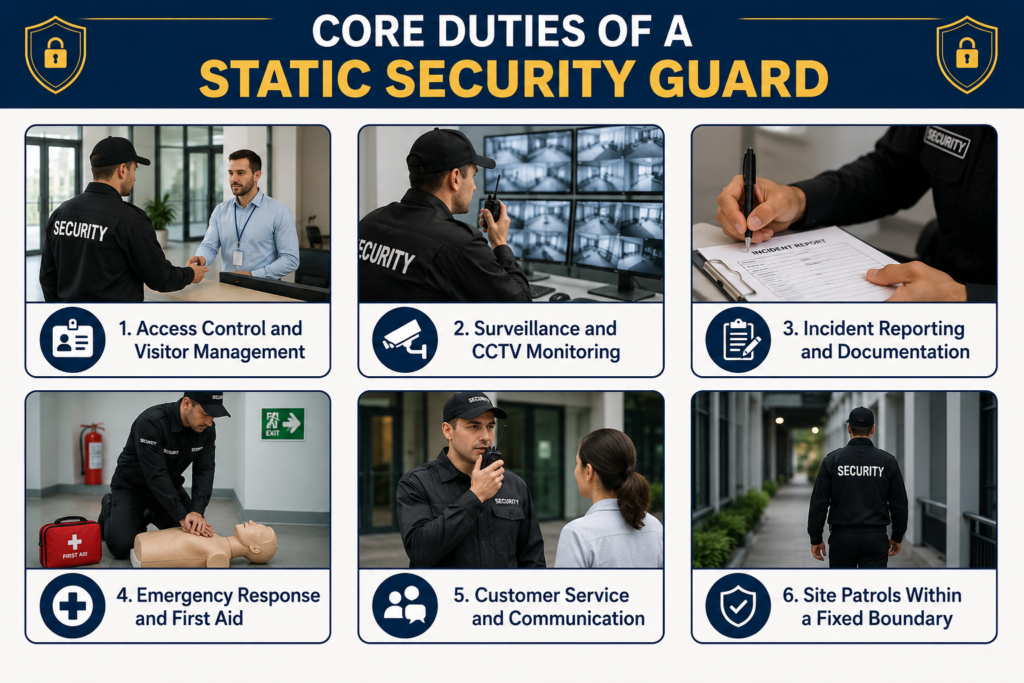
The day-to-day work depends on the site. A static guard at a Melbourne construction site spends most of the shift on gate control and perimeter checks. A static guard at a corporate office in Collins Street spends most of it on visitor management and concierge support. A retail static guard focuses on loss prevention and customer safety.
That said, the core responsibilities show up in almost every static role.
Access Control and Visitor Management
The first job of a static guard is deciding who gets in and who doesn’t. That covers signing visitors in and out, checking contractor IDs, monitoring delivery vehicles, issuing visitor passes, and turning away people without authorisation. On a construction site this often includes verifying White Card status. On a corporate site it usually means coordinating with reception and following a building’s specific access policy.
Surveillance and CCTV Monitoring
Static guards spend a portion of every shift monitoring CCTV feeds and conducting physical patrols inside their boundary. They watch for unattended bags, suspicious behaviour, fire hazards, vandalism in progress, and anything that’s out of place for the time of day. Good guards know what “normal” looks like for their site. That’s how they spot the things that aren’t.
Incident Reporting and Documentation
Every shift produces a log. Static guards record incidents with time, location, what happened, who was involved, and what action was taken. This paperwork matters. It supports insurance claims, police reports, and management decisions. At Walton Security, on-site supervision and structured incident reporting are part of the standard service, with photos and timestamps documenting every check.
Emergency Response and First Aid
A static guard is usually the first responder when something goes wrong on site. That covers medical emergencies, fire alarm activations, slip-and-fall incidents, security breaches, and aggressive behaviour from visitors or trespassers. Most Victorian licensed guards are required to hold current first aid and CPR certification before they can work a shift.
Customer Service and Communication
A guard at the front desk of an office tower is also the face of the building. They greet visitors, give directions, take deliveries, and handle the small interactions that shape how people feel about the property. The “security” half of the job is one part of the role. The “service” half matters just as much in concierge and retail settings.
Site Patrols Within a Fixed Boundary
Most static positions involve scheduled patrols. A guard might walk the perimeter every hour, check each floor of a building twice a shift, or rotate through several posts at a large warehouse. Patrol frequency comes from the site’s risk profile. High-value sites get more frequent patrols. Lower-risk sites get fewer.
Common Deployment Locations Across Melbourne
Static security covers a wide range of property types. Across Melbourne and Victoria, these are the deployment locations where you’ll most often see a static guard on duty.
- Construction sites. Gate control, perimeter monitoring, after-hours guarding to prevent theft of tools, copper, and machinery. The Australian construction industry loses an estimated $1.5 billion annually to theft and vandalism, which is why static cover is the default for active builds in places like Box Hill, Footscray, and the Docklands.
- Shopping centres and retail stores. Loss prevention, customer safety, car park patrols, and shoplifter de-escalation. Properly deployed retail static guards can reduce shrinkage by up to 40 percent.
- Corporate offices and commercial buildings. Reception support, visitor screening, after-hours building access, and lift control in Melbourne CBD towers along Collins Street, Bourke Street, and William Street.
- Hospitals and aged care facilities. Patient and staff protection, emergency department support, after-hours building access, and managing aggressive visitors.
- Warehouses and logistics centres. 24/7 perimeter watch, loading dock supervision, and vehicle access control at distribution sites in Laverton, Truganina, and Dandenong South.
- Residential apartment buildings. Concierge desk, parcel handling, late-night entry control, and resident safety in high-rise developments across Southbank and Docklands.
- Hotels and event venues. Lobby security, function room support, and after-hours room patrols at hotels around Southbank, the CBD, and St Kilda.
- Schools, universities, and training centres. Campus access control, after-hours building checks, and event support during open days and exams.
- Government and defence facilities. Compliance-driven access control, visitor screening, and asset protection.
The site type sets the duty mix. A guard at a hospital does very different work from a guard at a construction site, even though both are technically in static roles.
Licensing and Legal Requirements in Victoria
You can’t legally work as a static security guard in Victoria without a Private Security Licence. The licensing system sits under the Private Security Act 2004 and is administered by the Licensing and Regulation Division (LRD) of Victoria Police.
Here’s what’s required.
A current Victorian Private Security Licence. Static guard work falls under Class 1 operational licensing. Every applicant goes through a national police check, fingerprint identification, and a fit-and-proper-person assessment. The licence has to be carried while on duty.
A nationally recognised qualification. Most guards hold Certificate II in Security Operations (CPP20218), delivered by registered training organisations across Victoria. The course covers communication, de-escalation, legal powers, OH&S, and basic first aid.
A current first aid certificate, including CPR. This is renewed annually for CPR and every three years for the broader first aid component.
Site-specific inductions. A licensed guard still has to be inducted into each site they work, especially construction sites (where a White Card is mandatory) and high-security facilities.
Walton Security’s guards all hold current Victorian Private Security Licences and undergo thorough background checks, ongoing training, and active on-site supervision. ISO 9001, ISO 45001, and ISO 14001 certifications cover quality management, occupational health and safety, and environmental management across every shift.
Training and Skills a Static Security Guard Needs
The licence is the legal minimum. The skills that actually make a guard useful on site go further.
- Spotting what’s different about a normal day at this site. The skill comes from time on the job, not training videos.
- De-escalation. Talking down a frustrated contractor, an intoxicated patron, or a confused visitor without making the situation worse. Verbal skills do most of the work.
- Written communication. Incident reports need to be clear, factual, time-stamped, and free of opinion. Vague reports are worse than no reports at all.
- Physical fitness. Long shifts on your feet, the ability to walk a perimeter several times per shift, and the strength to handle an emergency response if needed.
- Composure under pressure. A guard who panics when an alarm goes off is a liability. Calm, defined responses keep small problems small.
- Customer service. Especially in retail, hotel, and residential settings. The guard is often the first face a visitor sees.
- Familiarity with site procedures. Knowing the evacuation route, the alarm codes, the emergency contacts, and the post orders for the specific site they’re working.
Training doesn’t stop after the certificate. Reputable Melbourne security companies run ongoing training in conflict management, fire warden duties, mental health first aid, and emergency procedures.
Static Security Guard vs Mobile Patrol vs Crowd Controller
These three roles get mixed up constantly. They’re different jobs with different licences, different deployment models, and different hourly rates.
Static security guard. One guard, one site, one shift. Continuous on-site presence. Best for active construction sites, retail stores, hospital lobbies, residential towers, and corporate buildings that need someone on hand at all times.
Mobile patrol officer. One guard, multiple sites, one shift. Drives a marked patrol vehicle between several locations on a scheduled or random route. Each visit usually lasts 10 to 20 minutes. Best for vacant properties, small business clusters, after-hours retail, and clients who want a regular check-in instead of full-time coverage.
Crowd controller. A different licence class entirely. Crowd controllers work licensed venues, festivals, sporting events, and public gatherings, focusing on patron management, ID checks, and de-escalation in alcohol-served environments. The Victorian crowd controller licence has stricter training requirements than the standard guard licence.
The right choice depends on the site, the risk, and the budget. A construction site that’s active 18 hours a day needs a static guard. A row of small retail units that close at 6pm probably gets better value from a mobile patrol that drives by every two hours overnight.
How Much Do Static Security Guards Cost in Melbourne?
Standard daytime static guard rates in Melbourne usually sit between AUD $35 and $65 per hour, depending on the site type, guard experience, and whether the contract is short-term or ongoing. Higher-risk sites and more experienced guards land at the upper end of the range.
A few things shift the price.
- Time of day. Night shifts (typically 10pm to 6am) attract a loading. Expect 15 to 25 percent above the standard rate.
- Weekends and public holidays. Saturday rates are higher than weekday rates, Sunday rates higher again, and public holidays usually attract a premium of 50 to 100 percent.
- Minimum shift length. Most Melbourne security companies have a minimum booking, often four hours. A two-hour booking still gets billed for four.
- Number of guards. Sites with two or more guards on duty often qualify for slightly lower per-guard rates than single-guard deployments.
- Contract length. Ongoing weekly or monthly contracts get better rates than one-off bookings.
- Site complexity. A guard at a single-entry shop is a different cost equation from a guard responsible for a multi-storey construction site with three access points.
The fastest way to get an accurate Melbourne quote is to share your site type, suburb, operating hours, and what you’re worried about. A reputable security company can give you a clear coverage plan and pricing within a day. Walton Security provides free site assessments and quotes through their CBD office.
When Do You Need Static Security Instead of Other Options?
Static is the right model when one or more of these signs are present at your site.
- The property is occupied, in use, or holds valuable assets for extended hours, and a check-in every two hours isn’t enough.
- You’ve had recent incidents (theft, trespass, vandalism, aggressive visitors) that need a daily preventative presence.
- Your site has high foot traffic that requires real-time access control and visitor management.
- You’re operating in a high-risk industry (construction, retail, hospitality, healthcare) where on-the-spot incident response is part of normal operations.
- Your insurance, contract, or compliance obligations require visible licensed security on site.
- Your staff are working late or alone in environments where a guard’s presence reduces real risk and concern.
Static guards aren’t always the answer. Vacant properties, low-risk sites, and clusters of small premises often get better protection per dollar from scheduled mobile patrols and alarm response, sometimes paired with monitored CCTV.
How Walton Security Deploys Static Guards Across Melbourne
Walton Security is a Melbourne-based ISO 9001, ISO 45001, and ISO 14001 certified security company providing licensed static guard services across the CBD, inner suburbs, and wider Victoria. Every guard holds a current Victorian Private Security Licence, and every shift is backed by active supervision and structured incident reporting.
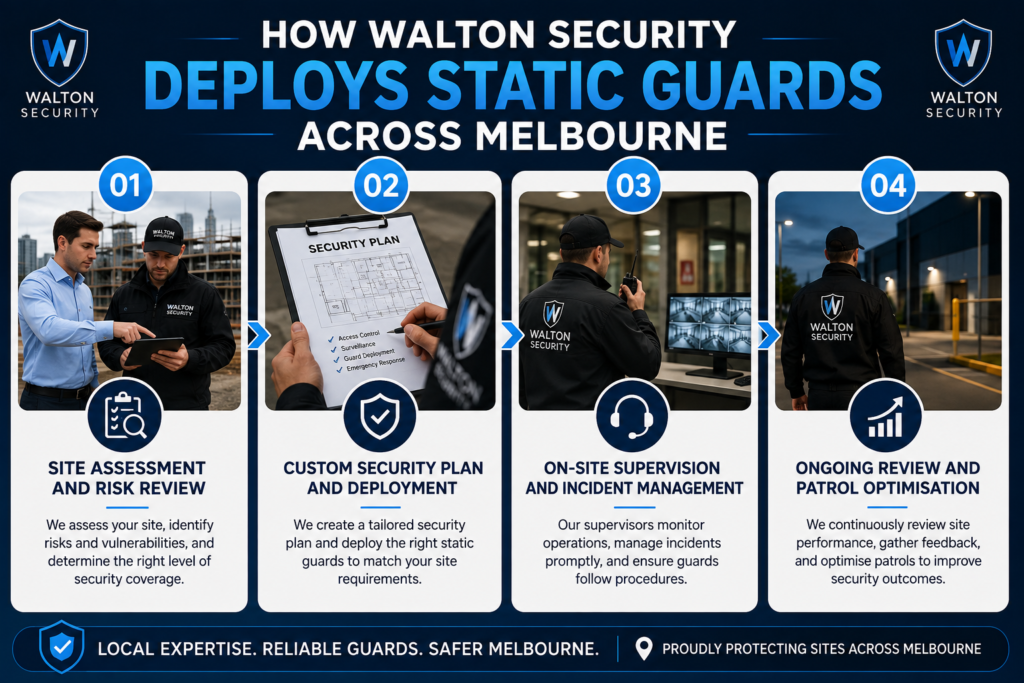
The deployment process runs in four steps:
- Site assessment and risk review. A walk-through to identify entry points, blind spots, busy hours, and past incident history. The goal is to match guard hours to actual risk, not overbook services.
- Custom security plan and deployment. A written plan covering guard role, post position, patrol schedule, access control rules, and incident escalation steps. You know exactly what the guard is doing before they start.
- On-site supervision and incident management. Guards follow defined post orders, log incidents in real time, and follow clear escalation procedures when serious events occur. Active supervision keeps service quality consistent across every shift.
- Ongoing review and patrol optimisation. Monthly reviews adjust patrol timing, post positions, and reporting based on what’s actually happening on site.
Coverage runs 24/7 across Melbourne CBD, Southbank, Docklands, South Melbourne, Port Melbourne, Carlton, Fitzroy, Collingwood, Richmond, and St Kilda, plus regional Victoria including Geelong, Ballarat, Bendigo, Mildura, and Shepparton. Response time on most callouts sits under 30 minutes.
To get a free quote, call Walton Security on 03 9970 8701, email info@waltonsecurity.com.au, or visit the office at 163/585 Little Collins Street, Melbourne VIC 3000.
FAQs About Static Security Guards
What is the difference between a static security guard and a mobile patrol guard?
A static guard stays at one fixed site for their entire shift. A mobile patrol guard drives between multiple sites in a single shift, usually visiting each one for 10 to 20 minutes. Static is the right choice for sites that need continuous on-site presence. Mobile patrols suit lower-risk sites or property clusters that need scheduled check-ins rather than full-time guarding.
How much does a static security guard cost in Melbourne per hour?
Standard daytime rates in Melbourne usually fall between AUD $35 and $65 per hour. Night shifts, weekends, and public holidays attract loadings on top of the base rate. Most security companies have a minimum shift length, usually four hours, so a shorter booking still gets billed at the four-hour minimum. Ongoing contracts almost always work out cheaper per hour than one-off bookings.
Are static security guards licensed in Victoria?
Yes. Every static security guard working in Victoria must hold a current Private Security Licence issued by Victoria Police’s Licensing and Regulation Division under the Private Security Act 2004. The licence has to be carried while on duty. Walton Security guards all hold current Victorian Private Security Licences, supported by national police checks, ongoing training, and active on-site supervision.
What qualifications does a static security guard need?
Most Victorian static guards hold Certificate II in Security Operations (CPP20218) delivered by a registered training organisation, plus a current first aid and CPR certificate. The certificate covers communication, de-escalation, legal powers, OH&S, and basic emergency response. Construction site work also requires a White Card. Some guards hold higher qualifications such as Certificate III in Security Operations for senior or supervisory roles.
Are static security guards armed in Melbourne?
No. The vast majority of static guards in Melbourne are unarmed. Armed guarding is heavily regulated in Victoria, requires a separate licence class, and is generally limited to cash-in-transit, high-value asset protection, and specific defence-related work. Walton Security operates as an unarmed licensed guard service, which fits 99 percent of Melbourne commercial, retail, residential, and construction site security needs.
Can a static security guard physically detain someone?
A licensed guard has the same powers of citizen’s arrest as any member of the public under Victorian law. They can detain someone they reasonably believe has committed an indictable offence until police arrive, but they can’t use unreasonable force. Most reputable Melbourne security companies train guards to avoid physical contact wherever possible, prioritising de-escalation, observation, witness statements, and prompt police involvement.
How long does a typical static guard shift run?
Standard shifts are 8 or 12 hours, with a four-hour minimum on most short-term bookings. Construction sites, hospitals, and 24/7 corporate buildings usually run two 12-hour shifts (day and night) or three 8-hour shifts in a 24-hour cycle. Victorian fatigue management rules and OH&S obligations limit how long a single guard can work consecutively, which is why active supervision and shift handovers matter.
Can I hire a static security guard for a single day or short-term event?
Yes. Walton Security and most Melbourne security companies handle short-term bookings, including one-day construction shutdowns, single-event coverage, and emergency same-day deployments. Short-term rates are usually higher per hour than ongoing contract rates, and most companies require a four-hour minimum. Same-day deployment depends on guard availability, but reputable companies can often have a guard on site within hours of confirming a booking.
What’s the difference between a static guard and a concierge security guard?
A concierge security guard is a static guard with a stronger customer service component. They handle reception duties, parcel deliveries, visitor sign-ins, and resident or staff support, while still maintaining security awareness, access control, and incident response. You’ll see concierge guards at corporate office towers in the CBD, residential apartment buildings in Southbank and Docklands, and high-end hotels.
How do I hire a reliable static security guard in Melbourne?
Start with licensing. Confirm the company holds proper insurance, that all guards are licensed under the Private Security Act 2004, and ask to see the supervision and incident reporting structure. A solid Melbourne security provider will offer a free site assessment, give you a written security plan, and explain exactly what the guard will do, where they’ll be posted, and how reporting works. Walton Security covers all of Melbourne and regional Victoria with ISO-certified processes, free site assessments, and 24/7 coverage. Call 03 9970 8701 or email info@waltonsecurity.com.au to get started.
Get Static Security Coverage in Melbourne
Static security is one of the most useful and cost-effective security tools available to Melbourne businesses, but only when the deployment plan actually matches the site’s risk. Whether you’re protecting a construction site in the western suburbs, a retail store in Chadstone, a corporate building in the CBD, or an event venue in Southbank, a properly deployed licensed static guard reduces real risk and gives staff and customers the confidence to get on with their day.
If you’d like a free site assessment and a clear written quote for static guard coverage in Melbourne or wider Victoria, Walton Security is ready to help. Call 03 9970 8701, email info@waltonsecurity.com.au, or drop into 163/585 Little Collins Street, Melbourne VIC 3000.