
Event Security: Definition, Meaning Duties, Solutions, Audit, and Management
Event security is the deployment of licensed, trained security personnel to protect attendees, staff, performers, and property at an organised gathering, from a 50-guest corporate function to a 20,000-person festival. In Melbourne every event guard must hold a current Victoria Police security licence, and the work covers far more than checking tickets: access control, crowd management, emergency response, and real-time risk assessment all run at once, under pressure, in a space that changes by the hour.
This guide defines event security properly, explains what it actually means for an organiser, breaks down guard duties, sets out the solutions available, covers how a security audit works before and after the event, and shows how the whole operation is managed. In Melbourne, organisers hire licensed event security to cover these demands, and every guard must be trained and licensed for the pressures of a live crowd. FAQs at the end answer the questions Melbourne event organisers ask most, including how many guards you need and how far ahead to book.
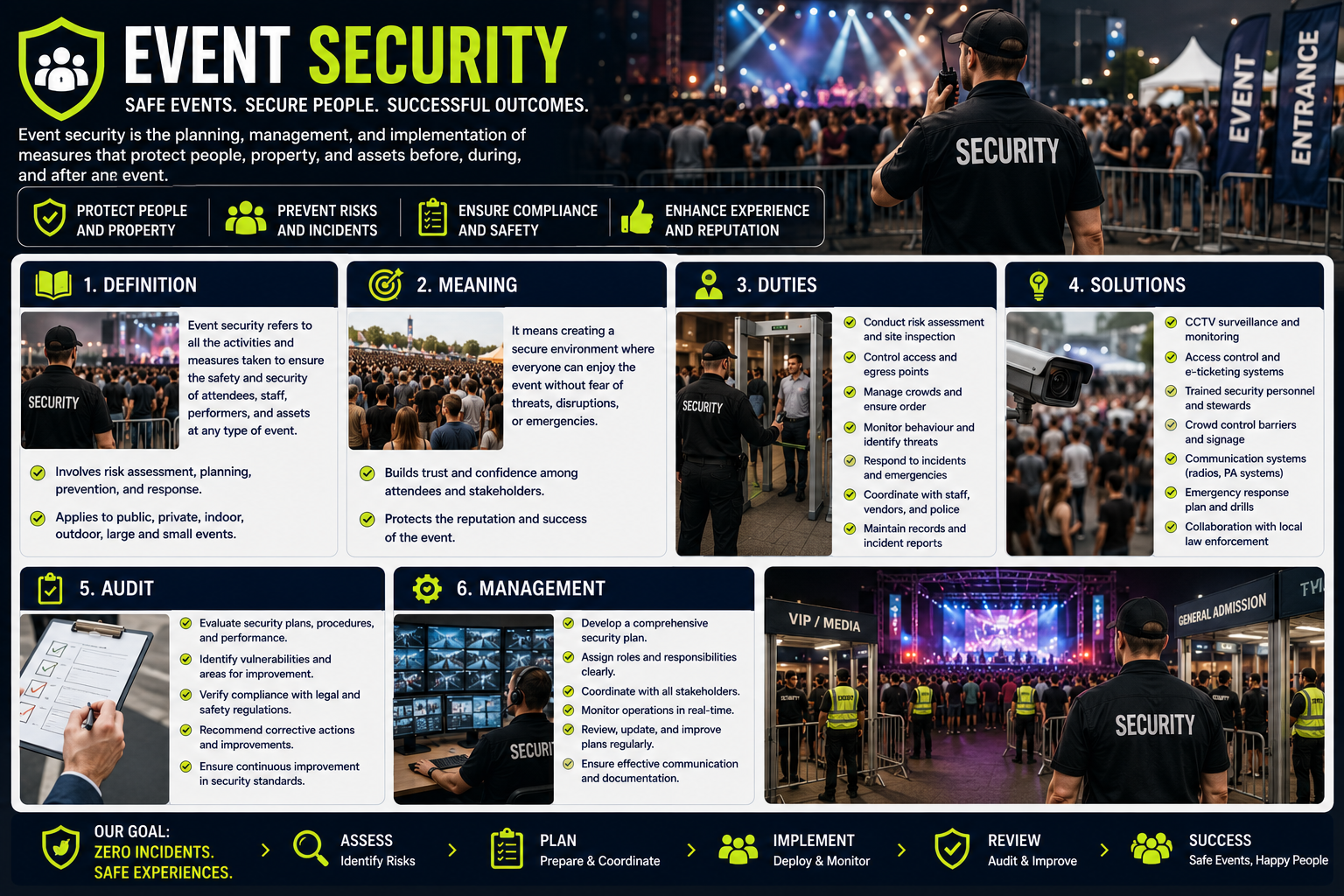
What Event Security Means
Event security means matching a protection plan to one specific gathering, then executing it live. It is not static site guarding relabelled. A warehouse has the same layout every night; an event has a crowd that arrives all at once, peaks, drinks, moves toward a stage, and leaves through the same gates within a fixed window. That dynamic is what event security exists to control.
Two things define it. First, licensing: under Victorian law, anyone working as an event guard or crowd controller must hold a current Victoria Police private security licence, carry insurance, and clear a background check. An untrained volunteer in a hi-vis vest is not event security and exposes the organiser to real liability. Second, planning: professional event security starts before the first guest arrives, with a venue assessment that sets guard numbers, positions, and response procedures against the specific risk of that event.
The distinction between event security and crowd control matters here. Event security is the full scope of safety management, including access control, patrols, screening, and emergency coordination. Crowd control is one function within it, managing the movement and behaviour of large groups. Most Melbourne events need both, delivered by the same licensed team.
For many Melbourne venues and councils, event security isn’t a choice either. Liquor licensing conditions, venue capacity rules, and council permits often require a minimum number of licensed crowd controllers on site, tied to expected attendance and whether alcohol is served. Treating security as an afterthought can mean a permit is refused or an event shut down. Building the security plan early, off a proper assessment, keeps the event both safe and compliant.
Types of Events That Need Security
Different events carry different risk, and the security plan changes with each. The gatherings that most often need professional guards in Melbourne fall into a few clear groups.
- Concerts, festivals, and live performances, where stage access, crowd surges, and backstage control drive the plan
- Corporate functions, conferences, and product launches, where access control and discreet, professional presence matter most
- Weddings, private parties, and celebrity events, where guest-list screening and privacy protection come first
- Sporting events and community gatherings, where crowd flow, traffic, and entry management dominate
- Licensed and alcohol-served events, where RSA-aware guards and conflict de-escalation are essential
Each type reshapes the ratio of static guards to mobile patrols, the amount of screening, and the emergency plan. A corporate awards night in Southbank and a music festival in the Yarra Valley both need event security, but almost nothing about the two deployments is identical.
Event Security Guard Duties
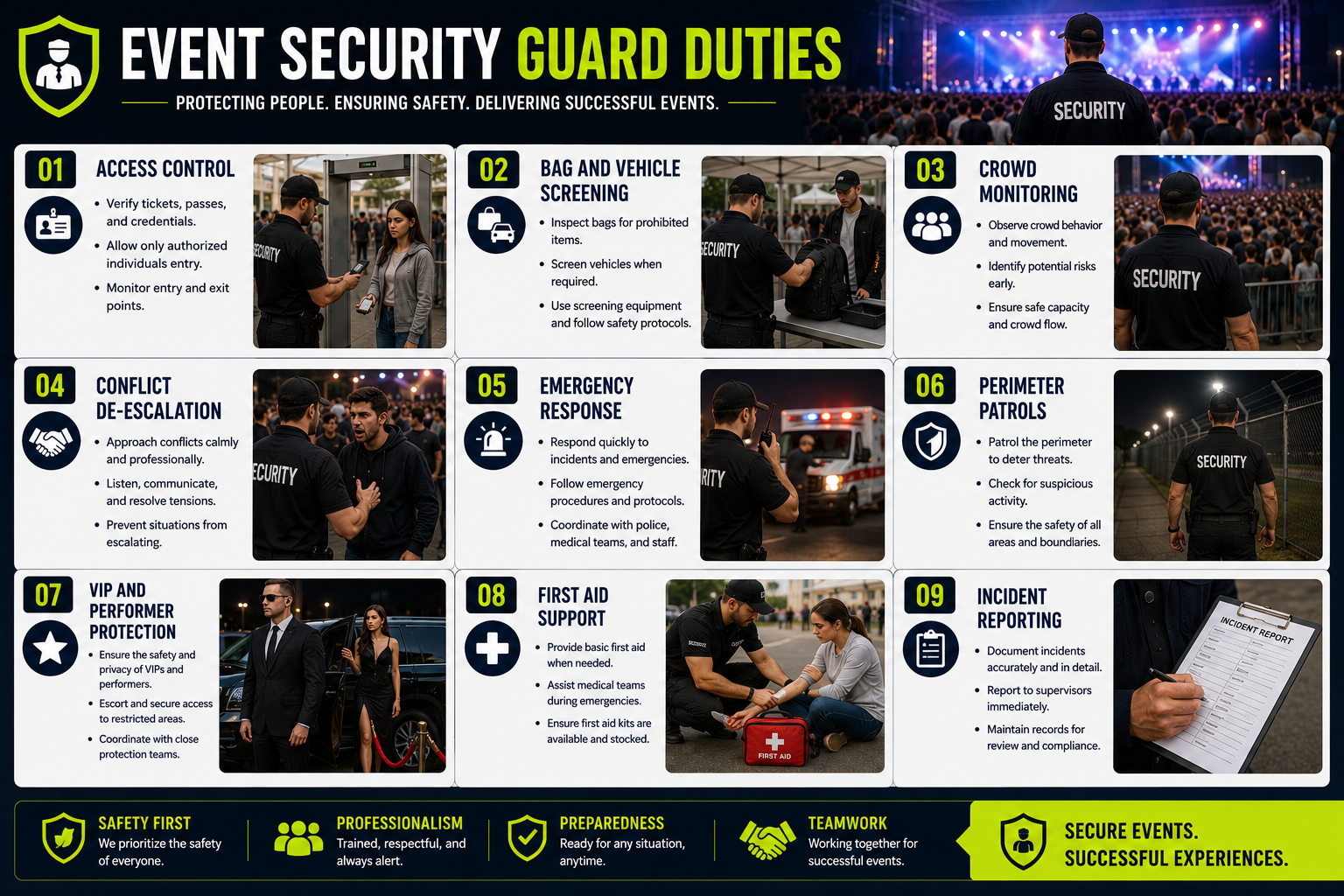
Most people picture an event guard checking tickets at the gate. Ticket-checking is one line on a long list. A professional event guard runs several concurrent responsibilities, and each one requires training, composure, and experience rather than a uniform alone.
The core duties on the ground are:
- Access control: verifying tickets, IDs, wristbands, and guest lists at every entry point, and turning away unauthorised entry firmly and politely
- Bag and vehicle screening: checking for prohibited items such as weapons, drugs, or outside alcohol before they reach the crowd
- Crowd monitoring: watching density, sightlines, and behaviour to catch dangerous surges or bottlenecks early
- Conflict de-escalation: stepping in the moment tension rises, before it turns physical
- Emergency response: coordinating with paramedics, police, and venue staff during medical events, evacuations, or security breaches
- Perimeter patrols: checking fence lines, back entrances, and restricted zones throughout the event, not just at the doors
- VIP and performer protection: close-cover for high-profile guests, stage access control, and backstage security
- First aid support: delivering basic first aid until emergency services arrive, which at a large event can decide the outcome
- Incident reporting: logging every incident with time, location, and action taken, which becomes the record for the post-event review
These duties don’t happen in sequence; they happen together, all night. That is why event work sits at the demanding end of the security industry and why briefing and supervision, covered further down, carry so much weight.
Common Event Security Risks
Good planning starts from the risks it has to prevent. Melbourne event organisers face a recurring set of security challenges, and naming them is the first step to controlling them.
The most common risks are unauthorised entry from gatecrashers who bypass access control, crowd surges and crushing when density isn’t monitored near stages and exits, and alcohol-related incidents at licensed events where intoxicated attendees become aggressive or vulnerable. Alongside these sit theft and pickpocketing in dense crowds, medical emergencies from heat exhaustion to seizures, anti-social or violent behaviour that escalates fast in high-energy settings, and privacy or filming breaches at private corporate functions and performances.
None of these are rare. Each one is predictable, which is exactly why a trained team plans for all of them before gates open rather than improvising when one occurs.
What separates a smooth event from a chaotic one is the planning done in advance. Before the first guest arrives, professional organisers set guard numbers against the venue and crowd, brief the team on the floor plan and schedule, agree a communication protocol, position visible uniformed guards as a deterrent, and walk through the evacuation plan. People behave differently when they can see trained security watching, so a visible, well-drilled presence prevents a large share of incidents before they ever start.
Event Security Solutions
Event security solutions are the specific services an organiser combines to cover their event’s risk profile. No single service protects a whole event; the plan layers several, sized to the crowd and venue.
The building blocks are static guards at fixed posts (entries, stages, restricted zones), mobile patrols covering perimeters and car parks across larger sites, dedicated crowd controllers for entry flow and queue management, and concierge or front-of-house security for corporate and VIP arrivals. Supporting these are entry screening and bag checks, CCTV and crowd-monitoring coverage, and close protection for performers or high-profile guests.
Technology increasingly supports the guards rather than replacing them. Surveillance cameras, crowd-monitoring tools, and real-time incident reporting through radios and mobile apps sharpen response times and keep the whole team coordinated. The right solution is a tailored combination, decided at the assessment stage, not a fixed package applied to every event the same way.
The Event Security Audit
A security audit is the assessment that bookends an event: a risk review before it starts and a performance review after it ends. Skipping either turns security into guesswork.
Before the event, the audit is a documented risk assessment of the venue and the gathering. It examines the floor plan, entry and exit points, expected attendance, crowd age and profile, alcohol presence, VIP areas, and emergency exits. That assessment sets three things: how many guards are needed, where they’re positioned, and how incidents escalate. It is also where the guard-to-attendee ratio is decided, the industry starting point being roughly one guard per 100 attendees, adjusted up for alcohol, large crowds, or elevated risk. A plan built on a real audit prevents both under-staffing that leaves gaps and over-booking that wastes budget.
After the event, the audit becomes a post-event review. The team analyses logged incidents, gathers feedback from staff and the organiser, and identifies what to change next time. This closes the loop: incident reports from the night feed directly into a stronger plan for the next event. For organisers running a recurring event, this before-and-after cycle is what turns a one-off security booking into year-on-year improvement.
How Event Security Is Managed
Managing event security is the operational layer that connects the plan to the people delivering it on the night. Three things make or break it: briefing, communication, and supervision.
Briefing comes first. Every guard needs the venue floor plan, the event schedule, VIP areas, emergency exits, and the names of key organisers before gates open. A well-briefed team responds faster and makes better calls, because they already know the ground. Communication comes next: guards coordinate with each other and with event management in real time through radios and earpieces, under a clear chain of command, so a problem spotted at one gate reaches the whole team in seconds. Supervision holds it together across the shift, with a supervisor ensuring posts are covered, incidents are logged properly, and escalation procedures are followed when something serious happens.
This is the difference between a group of licensed individuals and a functioning security operation. Clear post instructions, active on-site supervision, and real-time reporting keep coverage consistent from the first arrival to the final pack-down. The same discipline applies across guarded environments, from construction site security to retail loss prevention, not just events.
Frequently Asked Questions
How many security guards do I need for an event in Melbourne?
The starting benchmark is one guard per 100 attendees, but the real number depends on your event. Alcohol service, large or high-energy crowds, multiple entry points, and VIP guests all push the ratio higher. A risk assessment of the venue and event type sets the accurate figure rather than a flat rule.
What is the difference between event security and crowd control?
Event security is the full scope of safety management at an event, covering access control, screening, patrols, emergency response, and incident reporting. Crowd control is one function within it, managing the movement and behaviour of large groups. Most Melbourne events need both, delivered together by the same licensed team. You may also want the security guard vs bouncer comparison.
Do event security guards need a licence in Victoria?
Yes. Every event guard and crowd controller in Victoria must hold a current Victoria Police private security licence, carry insurance, and pass a background check. An unlicensed person, however well-meaning, is not legal event security and exposes the organiser to liability.
How far in advance should I book event security?
Book at least two to four weeks ahead for standard functions, and earlier for large-scale or high-risk events. Lead time allows a proper venue assessment, guard allocation, and team briefing, which are what make the deployment work. Last-minute bookings limit planning, so booking early gives the strongest coverage.
Do event security companies cover private events like weddings?
Yes. Event security applies to private functions such as weddings, birthdays, and celebrity events, as well as large public gatherings, with the same planning and licensing. Private events often prioritise guest-list screening and privacy protection, so the security plan is built around those specific needs rather than crowd volume alone.
What does an event security guard actually do?
An event guard runs several duties at once: access control and ticket checking, bag and vehicle screening, crowd monitoring, conflict de-escalation, emergency response, perimeter patrols, VIP protection, first aid support, and incident reporting. Ticket-checking is one small part. The role demands training and composure across every one of those responsibilities.
What happens if there is a medical emergency or fight at my event?
Trained guards respond immediately, delivering first aid until paramedics arrive and coordinating with police and venue staff during any serious incident. De-escalation stops most conflicts before they turn physical, and defined escalation procedures cover the rest. Every incident is logged with time, location, and action taken, which feeds the post-event review.
Do you provide a security plan or just guards?
Both. Professional event security starts with a documented risk assessment that sets guard numbers, positions, and emergency procedures, then delivers the licensed team to execute it and a review afterward. A proper service plans the event, staffs it, manages it on the night, and reviews it, rather than simply sending guards to a venue.
The Practical Takeaway
Event security is a planned operation, not a headcount at the door: a documented audit before the event, licensed guards executing layered solutions on the night, and a review afterward. Getting it right protects attendees, keeps the event compliant with Victorian licensing, and turns a recurring booking into year-on-year improvement. For the full scope of guarded event work in Melbourne, from crowd control to VIP protection, see Walton Security’s event security service page.