
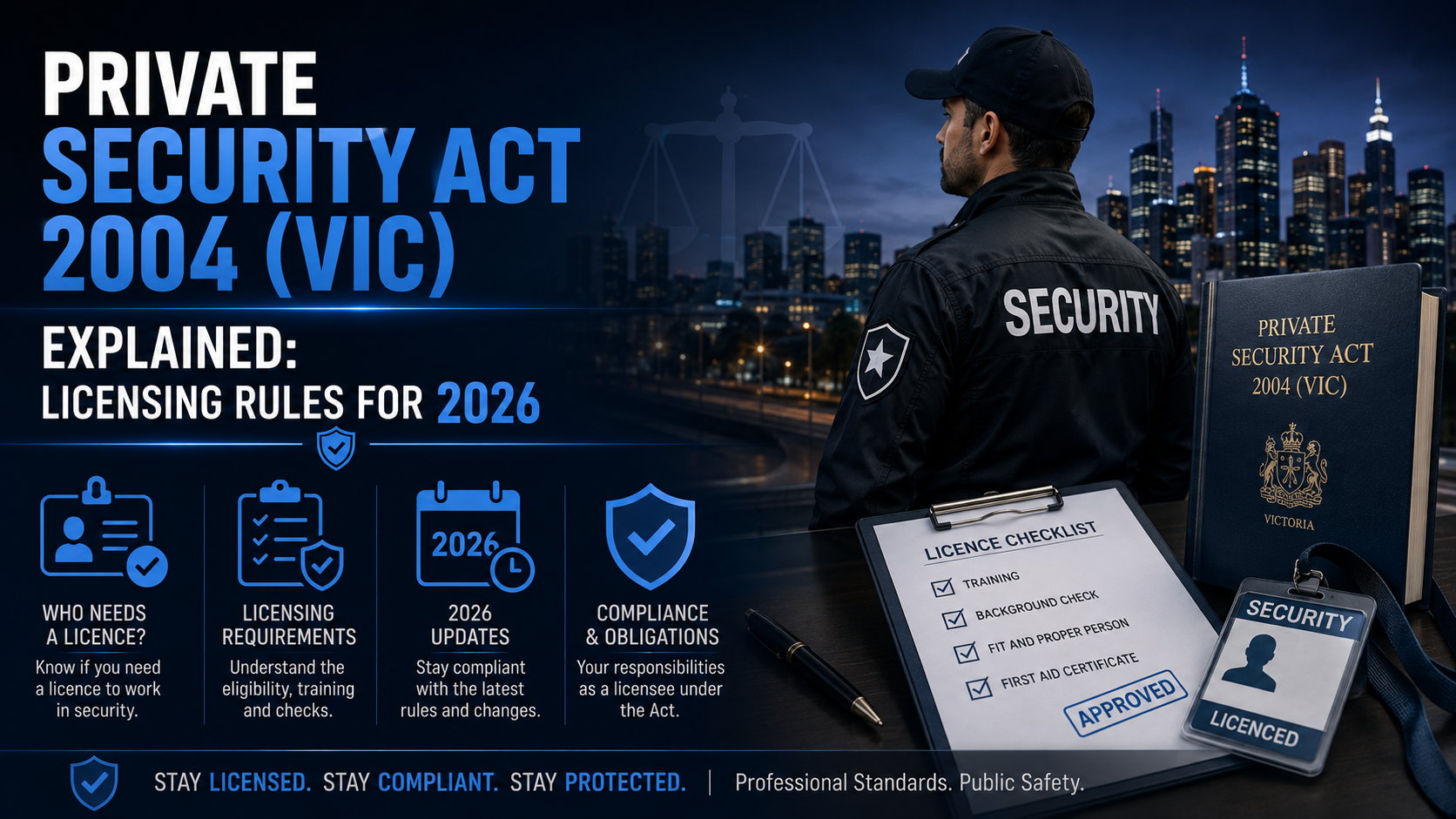
The Private Security Act 2004 (Vic) is the statute that decides who may lawfully guard property, control crowds, protect people, investigate, advise on security, or install security equipment in Victoria. It sets the licence categories, the probity tests, the training requirements and the offences for operating without authority. The Licensing and Regulation Division of Victoria Police administers it on behalf of the Chief Commissioner of Police.
The Act changed substantially on 19 June 2025, when the Private Security and County Court Amendment Act 2024 commenced. Registrations were abolished in favour of a single licensing system, holders of existing registrations had until 19 June 2026 to transition, and fingerprinting plus criminal history probity became mandatory for those transitioning. From 19 December 2025, independent contractors and sole traders with an ABN must hold both a Private Security Business licence and a Private Security Individual Operator licence under section 15A, a change aimed squarely at sham contracting. The Private Security Regulations 2025 replaced the 2016 Regulations at the same time.
More is coming. From 5 October 2026, renewing an individual operator licence requires an approved first aid course, plus Victoria Police approved refresher training for anyone whose activities include security guard, crowd controller or bodyguard. Training benchmarks sit at CPP20218 Certificate II in Security Operations (130 hours for unarmed guard, crowd control and control room operator) and CPP31318 Certificate III in Security Operations (112 hours for armed guard).
This article explains what the Act regulates, the licence types and activities, the eligibility and probity tests, the 2025 and 2026 changes in detail, training requirements, business obligations, the public register, penalties and VCAT review, and what a Victorian business should verify before signing a security contract.
What the Act regulates
The Act regulates activities, not job titles. If a person carries out a listed private security activity for reward, they need the matching authority regardless of what their employer calls the role. That structure catches concierge staff doing access control, event staff doing entry screening, and site supervisors doing patrols.
Its stated purpose is to provide for licensing of participants in the private security industry and to regulate the industry for public safety and peace. Two mechanisms deliver that. Probity screening keeps unsuitable people out. Competency requirements ensure those inside can do the work safely. Both apply to individuals and to the businesses that employ them.
Enforcement sits with the Licensing and Regulation Division, which processes applications, maintains the public register, conducts compliance activity and refers serious matters onward. Understanding which activity a role falls under is the first practical step.
Licence types and security activities
Two licence types exist after the 2025 reform. A Private Security Individual Operator licence covers a person carrying out an activity. A Private Security Business licence covers a business supplying those services, including body corporate applicants.
Activities endorsed on a licence include:
- Security guard, covering unarmed guard, armed guard, control room operator and monitoring centre operator sub-activities.
- Crowd controller, covering entry control and patron management at licensed premises and events.
- Bodyguard, covering close personal protection work.
- Private investigator, covering surveillance and factual investigation.
- Security adviser, covering advice on security methods and equipment.
- Security equipment installer, covering installation of alarms, locks and electronic systems.
Every activity performed must appear on the licence. A guard endorsed only for unarmed guarding cannot lawfully work a crowd control shift at a licensed venue, and a business supplying crowd controllers must hold the matching business endorsement. Our crowd control team and VIP protection officers hold separate activity endorsements for exactly that reason. Eligibility is where most applications stall.
Eligibility and the probity test
Applicants must be 18 years or over, be an Australian resident or hold a current visa with working rights, and submit a full set of fingerprints. Applicants who have lived in another country for more than 12 months in the past 10 years since turning 16 must supply certified international police checks for each of those countries.
Fingerprinting through Livescan is now mandatory, including for registration holders transitioning to a licence. Prints must be taken within six months of the application, and one set can support both a business and an individual operator application. Photographs are captured at authorised photo points across Victoria.
The probity test looks at criminal history, findings by other regulators, and conduct that bears on fitness to hold a licence. The Chief Commissioner assesses whether the applicant is a fit and proper person, and for business applicants the assessment extends to close associates and to officers of a body corporate named in the statement of related people. Ongoing obligations under Part 10 require licence holders to notify changes to close associates, changes to officers, and any criminal charges.
Two requirements were removed on 19 June 2025. Individual operator and business applicants no longer submit suitability references, and business or body corporate applicants no longer submit suitability references for associates. That reduction reflects the shift toward fingerprint-based probity.
The 2025 reform in detail
The Private Security and County Court Amendment Act 2024 delivered the largest change to the framework since 2004. Before it, the Act split activities into Class A for licences (crowd controller, security guard, private investigator among others) and Class B for registrations (security equipment installer, security adviser). That split is gone.
Key elements of the reform:
- Introducing a single licensing system and ceasing business registrations entirely.
- Requiring registration holders to apply for a licence by 19 June 2026 or by earlier expiry.
- Applying fingerprint and criminal history probity to every transitioning applicant.
- Mandating dual licences for ABN contractors from 19 December 2025 under section 15A.
- Remaking the Regulations as the Private Security Regulations 2025.
Sections 192 and 193 of the amending Act preserved registrations where a licence application was lodged before the deadline, so a registration stays in force until the licence issues or the application is refused. Section 36(4) works the same way for renewals, and the public register shows those licences as current pending renewal. Some registrations remain valid past 19 June 2026 while transition applications are finalised.
Section 15A deserves separate attention from businesses. An independent contractor carrying on a security activity under an ABN now needs both licence types, which works alongside Commonwealth and state sham contracting laws. Private investigators are excluded from that dual requirement.
Training and qualification requirements
Training requirements attach to activities. CPP20218 Certificate II in Security Operations covers unarmed guard, crowd control and control room operator at 130 hours. CPP31318 Certificate III in Security Operations covers armed guard at 112 hours, and CPP31418 Certificate III in Close Protection Operations applies to bodyguard work. Security adviser and security equipment installer activities carry no training qualification requirement.
Registered training organisations deliver and assess the qualifications, and Victoria Police maintains the approved list. Evidence of training not previously submitted is valid for 12 months from completion, and a person out of the industry for more than 12 months must retrain before reapplying.
From 5 October 2026, two new renewal conditions apply to individual operator licences. Everyone renewing needs an approved first aid course. Anyone whose activities include security guard, crowd controller or bodyguard also needs Victoria Police approved refresher training. Holders whose only activity is security guard monitoring centre operator need the first aid course but not the refresher. These conditions flow directly from the 19 June 2025 amendments, and operators should plan renewal timing around them.
Obligations on security businesses
Businesses carry obligations that go beyond holding a licence. They must ensure every employee is licensed for the activity being performed, check the public register regularly, keep employment and rostering records, and meet the notification duties in Part 10 when officers or close associates change.
Employment law runs alongside. The Security Services Industry Award 2020 (MA000016) sets minimum rates, with the Level 1 base rate at $28.42 per hour from 1 July 2026 and casuals at $35.53 including the 25 per cent loading. Sunday work attracts double time and public holidays two and a half times base. Underpayment through flat rates that ignore night and weekend loadings is a recurring compliance failure in the industry.
Work health and safety adds a third layer through the Occupational Health and Safety Act 2004 (Vic), enforced by WorkSafe Victoria. Guards working alone at night, on construction sites, or in venues with violence risk require documented controls. Walton Security operates ISO 9001, ISO 45001 and ISO 14001 certified management systems covering quality, work health and safety, and environmental performance across our full service range.
The public register and how to use it
The Register of Licence, Registration and Permit Holders is the verification tool the Act provides to the public. It is searchable by name or by licence number, and it lists all current individual and business holders regardless of the printed expiry date on the card.
Suspended, cancelled or expired authorities without a pending renewal do not appear. That absence is the signal to act on. Licences issued from August 2025 onward display abbreviated activity titles on the plastic card and on the register, a change that catches out clients who expect the older wording.
Checking the register is the employer’s and the client’s responsibility, not the guard’s. A business hiring a contractor should verify both the business licence and the individual operator licences of the guards actually rostered. Our clients receive licence numbers on request as part of every contract file.
Penalties, enforcement and VCAT review
Carrying on a security activity without the required licence is an offence under the Act, and so is employing an unlicensed person to do that work. Penalties attach to both the individual and the business, and repeat or serious conduct supports cancellation.
The Chief Commissioner can refuse, suspend or cancel a licence where the holder is no longer a fit and proper person. Conduct that commonly triggers action includes assault during a removal, unlawful detention, failing to disclose criminal charges, and breaching licence conditions. Outstanding VCAT investigations against a registration continued through the transition period rather than lapsing.
Review rights matter. Decisions of the Chief Commissioner are reviewable at the Victorian Civil and Administrative Tribunal, which can affirm, vary or set aside a decision. Clients affected by a provider’s licence issues have no direct role in that process, which is why due diligence at contract stage carries more weight than remedies afterwards.
What businesses should verify before hiring
Verification takes minutes and prevents the two failure modes that matter: unlicensed personnel on site, and a provider whose insurance does not respond after an incident. Work through a short list before signing.
- Confirm the Private Security Business licence number on the public register.
- Confirm the individual operator licence and endorsed activities for each rostered guard.
- Request certificates of currency for public liability and workers compensation.
- Ask which award classification and penalty rates the quoted hourly charge covers.
- Review written post orders, incident reporting format and escalation contacts.
Providers who answer those five questions without hesitation are usually the providers who run compliant operations. Detailed comparison points sit in our guide to questions to ask before hiring security guards, and the practical differences between roles are covered in security guard vs crowd controller.
Frequently asked questions
What does the Private Security Act 2004 (Vic) cover?
It covers licensing and regulation of private security activities in Victoria. Security guard, crowd controller, bodyguard, private investigator, security adviser and security equipment installer are the regulated activities, and the Licensing and Regulation Division of Victoria Police administers the Act.
What changed in the Act on 19 June 2025?
The Private Security and County Court Amendment Act 2024 introduced a single licensing system. Business and individual registrations ceased, holders were required to transition to licences by 19 June 2026, and fingerprint plus criminal history probity became mandatory for those transitions.
Do security registrations still exist in Victoria?
No, registrations were abolished by the 2025 reform. Registration holders had to apply for a licence by 19 June 2026, and under sections 192 and 193 a registration stays in force where the application was lodged before that date, until the licence issues or the application is refused.
Do sole traders need two licences?
Yes, if they hold an ABN relating to the security activity. Section 15A requires both a Private Security Business licence and a Private Security Individual Operator licence from 19 December 2025. Private investigators are exempt from the dual requirement.
What are the eligibility requirements for a Victorian security licence?
Applicants must be 18 or over, be an Australian resident or hold a visa with working rights, and provide fingerprints. International police checks are required for any country lived in for more than 12 months during the past 10 years since turning 16.
What training is required for a security guard licence in Victoria?
CPP20218 Certificate II in Security Operations at 130 hours covers unarmed guard, crowd control and control room operator. CPP31318 Certificate III in Security Operations at 112 hours covers armed guard, and security adviser and equipment installer activities have no training requirement.
What changes on 5 October 2026?
Renewal of an individual operator licence requires an approved first aid course from that date. Refresher training approved by Victoria Police also applies where the licence includes security guard, crowd controller or bodyguard activities. Monitoring centre operators need only the first aid course.
How do I check whether a security company is licensed?
Search the Register of Licence, Registration and Permit Holders by name or licence number. Suspended, cancelled and expired authorities do not appear on the register, so an absent result is a reason to stop and ask questions before engaging the provider.
Can a guard work while their renewal is being processed?
Yes. Section 36(4) deems a licence to continue in force after expiry once a renewal application is lodged, until the Chief Commissioner decides. The register displays those licences as current pending renewal.
What happens if a business uses unlicensed guards?
Both the individual and the business commit offences under the Act. Penalties apply to the employer as well as the worker, and the conduct feeds into fitness assessments that can lead to suspension or cancellation of the business licence.
Can a licensing decision be appealed?
Yes, at the Victorian Civil and Administrative Tribunal. VCAT can affirm, vary or set aside decisions of the Chief Commissioner, including refusals, suspensions and cancellations. Investigations underway at the time of the registration transition continued to completion.
Does the Act cover CCTV monitoring?
Yes, through the control room operator and monitoring centre operator sub-activities of the security guard category. Surveillance itself is also governed by the Surveillance Devices Act 1999 (Vic) and the Privacy Act 1988 (Cth), which apply alongside the licensing framework and are covered in our mobile patrols vs CCTV monitoring comparison.
Summary
The Private Security Act 2004 (Vic) licenses activities rather than job titles, and the Licensing and Regulation Division of Victoria Police administers it for the Chief Commissioner. Six activities are regulated, two licence types exist since the 2025 reform, and probity now runs on fingerprints and criminal history rather than suitability references.
The Private Security and County Court Amendment Act 2024 ended registrations, set the 19 June 2026 transition deadline, and imposed dual licensing on ABN contractors from 19 December 2025. Training sits at CPP20218 and CPP31318 depending on activity, with first aid and refresher training added to individual operator renewals from 5 October 2026. Businesses carry parallel duties under the Security Services Industry Award 2020 and the Occupational Health and Safety Act 2004 (Vic), and the public register is the tool clients use to verify any provider before signing.
Walton Security holds current Victorian private security licences across every activity we supply, backed by ISO 9001, ISO 45001 and ISO 14001 certification. Call 03 9970 8701, email info@waltonsecurity.com.au, or request licence details and a quote.