
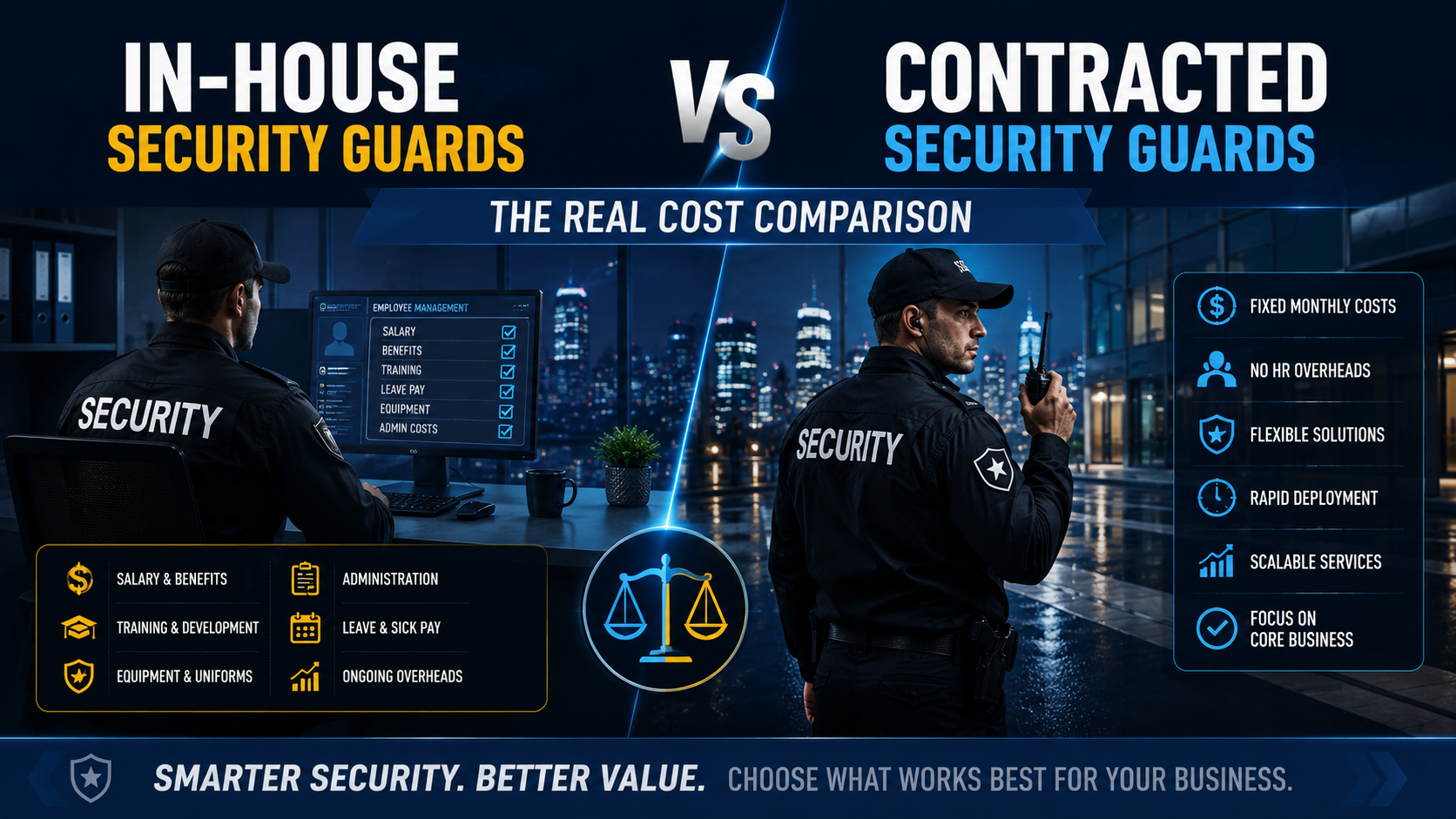

In-house security (guards employed directly by the business they protect) and contracted security (guards supplied by a licensed security business under a service agreement) differ on cost structure, legal exposure and coverage reliability rather than on the quality of the person standing at the gate. Both models operate under the Private Security Act 2004 (Vic), both require individual operator licences endorsed for the activity performed, and both answer to the Licensing and Regulation Division of Victoria Police.
The decisive difference is who carries the obligations. An employer running in-house guards carries award compliance under the Security Services Industry Award 2020 (MA000016), superannuation at 12 per cent, workers compensation, roster coverage for leave and illness, training costs, uniform, equipment, supervision, and licence tracking for every individual. A business engaging a contractor transfers those to the provider and pays a single hourly charge-out rate. Since 19 December 2025, section 15A also requires ABN contractors to hold both a business licence and an individual operator licence, which changes how sole trader arrangements work.
Raw numbers set the frame. The award Level 1 base rate is $28.42 per hour from 1 July 2026, casuals $35.53 including the 25 per cent loading, Sundays at double time and public holidays at two and a half times base. On-costs typically add 25 to 40 per cent before supervision, recruitment and coverage risk are counted, which is why an in-house rate that looks cheaper on paper often is not.
This article compares the true cost of each model, the licensing and compliance load, coverage and continuity, supervision and quality control, liability and insurance, training obligations, control and culture, the hybrid model, and how to decide.
What each model actually means
In-house means employment. The guard appears on your payroll, wears your uniform, reports to your manager, and holds a Private Security Individual Operator licence that your business is responsible for verifying. Notably, a business employing guards for its own premises still needs to meet the Act’s requirements for the activities being performed.
Contracted means procurement. A licensed security business supplies rostered guards under an agreement covering hours, duties, reporting and escalation. The provider employs the guards, holds the Private Security Business licence, carries the insurance, and manages replacement when someone calls in sick.
A third arrangement, engaging individual sole traders directly, sits between the two and carries the most risk. Sham contracting exposure, award underpayment claims and the section 15A dual licence requirement all land on the engaging business. Most Melbourne organisations that try it move to one of the two clean models within a year, usually after their first coverage gap or first compliance letter.
The true cost of in-house guards
Cost modelling for in-house security fails when it stops at the hourly wage. Direct wages are the smallest surprise in the model.
The full stack includes:
- Base wages from $28.42 per hour under the Security Services Industry Award 2020.
- Penalty rates covering nights, Saturdays, Sundays at double time and public holidays at 2.5 times.
- Superannuation guarantee contributions at 12 per cent.
- Workers compensation premiums, which sit high for security occupations.
- Annual leave, personal leave and leave loading for permanent staff.
- Recruitment, induction, uniform, equipment and licence verification.
- Supervision time from a manager who is not a security specialist.
Coverage adds the hidden cost. A single post staffed 24 hours a day, seven days a week needs roughly 4.2 full-time equivalents once leave, illness and rostered days off are included. Staff one post with fewer and every absence becomes overtime or an unstaffed shift. That maths is why in-house works best for large, stable, weekday-heavy requirements and struggles with overnight or weekend cover.
The true cost of contracted guards
Contract pricing arrives as one number: an hourly charge-out rate that includes wages, penalties, superannuation, workers compensation, public liability insurance, supervision, training, uniform, equipment and margin. That single number is what makes budgeting straightforward and comparison easy.
It also makes bad quotes easy to spot. A rate that does not change between a Tuesday day shift and a Sunday night shift cannot be paying award penalty loadings, which means either the guards are being underpaid or the provider is absorbing losses that will show up as staff turnover. Ask any provider to state the classification level and the penalty basis behind the quote in writing.
Contracts scale in both directions. Adding a second guard for a busy trading period, extending hours during a project, or standing the service down between phases all happen inside the agreement without redundancy or recruitment. Our security guard services are structured that way because most Melbourne sites have seasonal or project-driven demand rather than flat demand.
Licensing and compliance burden
Compliance is where the models diverge most sharply, and the 2025 reforms widened the gap.
An in-house employer must verify each guard’s individual operator licence, confirm the activities endorsed match the duties performed, check the Register of Licence, Registration and Permit Holders regularly, track renewal dates, and manage the transition and training changes flowing from the Private Security and County Court Amendment Act 2024. From 5 October 2026, every individual operator licence renewal requires an approved first aid course, plus Victoria Police approved refresher training for guard, crowd controller and bodyguard activities.
A contracting client verifies once: the provider’s Private Security Business licence, plus confirmation that rostered individuals hold matching endorsements. The provider carries the tracking. Our guide to the Private Security Act 2004 (Vic) sets out the full obligation list, and the practical verification steps appear in our questions to ask before hiring guide.
Coverage, continuity and surge capacity
Continuity separates the models more visibly than cost. A contracted provider maintains a pool. When a guard calls in sick at 5 am, a replacement is dispatched from that pool. When an in-house guard calls in sick at 5 am, a manager starts phoning people who are not obliged to answer.
Surge capacity works the same way. A retail site needing four extra guards for a Boxing Day trading period, or a construction site needing overnight cover during a concrete pour, gets those hours from a contractor’s roster. Building the same flexibility in-house means carrying casuals who are underused for most of the year.
Specialist coverage is the third gap. Crowd control at a licensed event, close protection for a visiting executive, or emergency response deployment each need specific licence endorsements. Few in-house teams carry all of them, and the differences between roles are covered in security guard vs crowd controller.
Supervision and quality control
Supervision quality determines outcome quality in both models, and the failure mode differs. In-house teams often report to a facilities or operations manager with no security background, which means post orders drift, reporting standards slip, and nobody audits whether patrols actually happened.
Contracted supervision is a specialist function. Field supervisors visit sites, audit checkpoint scans, review incident reports for quality, and run refresher briefings. Walton Security operates active supervision with real-time reporting, defined escalation protocols and monthly coverage reviews as standard, under ISO 9001 quality management certification.
Reporting is the measurable proxy. Ask either model to produce last month’s incident log and patrol records. If the answer takes more than a day, the supervision layer is not working, regardless of who employs the guards.
Liability, insurance and risk transfer
Liability follows employment. An in-house guard who uses excessive force during a removal, detains someone unlawfully, or is injured on shift creates exposure that sits with the employing business, including vicarious liability for the guard’s conduct and workers compensation for the injury.
Contracted arrangements transfer much of that. The provider carries public liability and workers compensation, and a properly drafted agreement allocates responsibility for conduct on site. Certificates of currency should be requested at contract stage and refreshed annually, not assumed.
Neither model removes the client’s own duty. The Occupational Health and Safety Act 2004 (Vic) imposes obligations on the occupier for the safety of everyone at the workplace, including contractors. Lone worker controls, lighting, safe access and emergency procedures remain the site owner’s responsibility whoever employs the guard. Our detention guide covers the conduct risks in detail at can a security guard detain you.
Training and skills currency
Training obligations sit with the employer, and they keep expanding. CPP20218 Certificate II in Security Operations at 130 hours is the entry qualification for unarmed guard, crowd control and control room operator activities. CPP31318 Certificate III at 112 hours covers armed guard and senior roles.
Beyond the qualification, competent operations require ongoing work: de-escalation refreshers, first aid currency, site-specific inductions, emergency procedure drills and reporting standards. An in-house employer funds and schedules all of it. A contracted provider absorbs it into the charge-out rate and delivers it across a workforce large enough to make the training economical.
The 5 October 2026 renewal conditions make this concrete. First aid and refresher training become licensing prerequisites, and businesses running in-house teams need those bookings scheduled well ahead of each individual’s renewal date to avoid a guard becoming unable to work.
Control, culture and site knowledge
Control is the strongest argument for in-house. Directly employed guards learn the building, know the staff by name, follow internal procedures without translation, and integrate with reception, facilities and health and safety teams. Corporate headquarters, hospitals and universities often value that continuity above the cost difference.
Contracted teams close that gap with stability rather than employment. Requesting named regular guards, keeping written post orders current, and running quarterly reviews produces site familiarity without payroll exposure. Long-running concierge security contracts frequently have the same officers on the desk for years.
Where culture genuinely requires internal identity, the hybrid model resolves it.
The hybrid model
Hybrid staffing keeps a small in-house core and contracts the variable load. The core covers business hours, holds the site knowledge and manages relationships. The contractor covers nights, weekends, leave relief, peak periods and specialist activities.
This structure suits shopping centres, hospitals, universities and large corporate campuses, where weekday demand is predictable and after-hours demand is not. It caps headcount, removes overtime spirals, and keeps specialist endorsements available on call.
Walton Security runs blended arrangements for Melbourne clients across shopping centre and hotel portfolios, with written post orders shared between internal and contracted personnel so both work to one standard.
Frequently asked questions
Is in-house security cheaper than contracted security?
Rarely, once full costs are counted. Wages, 12 per cent superannuation, workers compensation, leave, training, uniform and supervision typically add 25 to 40 per cent on top of the hourly rate, and 24/7 coverage of one post needs about 4.2 full-time equivalents.
Do in-house guards need a security licence in Victoria?
Yes. The Private Security Act 2004 (Vic) licenses activities, not employment arrangements, so directly employed guards need individual operator licences endorsed for the work performed, and the employer must verify them on the public register.
What are the risks of hiring individual guards as contractors?
Sham contracting and underpayment claims are the main ones. Section 15A requires ABN contractors to hold both business and individual operator licences since 19 December 2025, and the engaging business carries exposure if that structure is not correct.
Who is liable if a guard uses excessive force?
The employer carries vicarious liability alongside the individual. In-house means your business carries it, while a contracted arrangement places it with the provider, subject to the agreement and their public liability cover.
How many guards do I need for 24/7 coverage?
About 4.2 full-time equivalents per post. Leave, personal leave and rostered days off consume roughly 20 per cent of available hours, so staffing at four or fewer produces overtime costs or unstaffed shifts.
What insurance should a contracted provider hold?
Public liability and workers compensation at minimum, with certificates of currency provided at contract stage. Certificates should be refreshed annually, and the agreement should state who carries responsibility for conduct on site.
Can I mix in-house and contracted guards?
Yes, and many Melbourne sites do. A small in-house core covers business hours and site knowledge, while a contractor covers nights, weekends, leave relief and specialist activities such as crowd control or close protection.
What happens when an in-house guard is sick?
The employer arranges replacement, usually through overtime or an unstaffed shift. Contracted providers dispatch from a rostered pool, which is the single most common reason businesses switch after a coverage failure.
How do I compare contractor quotes fairly?
Compare the same days and hours, and ask each provider to state the award classification and penalty basis. A flat rate that never changes between weekdays and Sundays cannot be paying award loadings, which signals underpayment or unsustainable pricing.
Does contracting reduce my work health and safety duties?
No. The Occupational Health and Safety Act 2004 (Vic) obliges the occupier to provide a safe workplace for contractors as well as employees, covering lighting, safe access, lone worker controls and emergency procedures.
Which model suits construction sites?
Contracted, almost always. Construction demand is project-based and shifts phase by phase, so recruiting permanent staff for a build with a fixed end date creates redundancy exposure that a service agreement avoids.
How long does it take to set up a contracted service?
Most Melbourne sites move from assessment to first shift within a week. A site visit, written post orders and licence verification are the three steps ahead of commencement, and urgent deployments can start sooner where the risk profile is straightforward.
Which model suits corporate head offices?
Either, and hybrid often works best. In-house suits stable weekday requirements with heavy staff interaction, while contracted cover handles nights, weekends and surge without adding permanent headcount.
Summary
In-house and contracted security guards work under the same Private Security Act 2004 (Vic) licensing framework, and the choice turns on cost structure, compliance load and coverage reliability rather than guard quality. In-house employment brings award obligations from $28.42 per hour base, 12 per cent superannuation, workers compensation, leave cover at roughly 4.2 full-time equivalents per 24/7 post, training funding and licence tracking that tightens again from 5 October 2026.
Contracted supply consolidates all of that into one hourly charge-out rate, transfers much of the liability and insurance exposure, supplies replacement staff from a rostered pool, and provides specialist endorsements on demand. Control and site familiarity remain the strongest in-house arguments, and named regular officers with current written post orders close most of that gap. Large stable sites frequently land on a hybrid, keeping a small internal core and contracting nights, weekends, leave relief and peaks.
Walton Security supplies licensed guards across Melbourne and regional Victoria under ISO 9001, ISO 45001 and ISO 14001 certified systems, with active supervision and written reporting on every shift. Call 03 9970 8701, email info@waltonsecurity.com.au, or request a costed coverage plan.