

A bag search (a consent-based inspection of a person’s belongings) is a request, not an order, and a security guard in Victoria has no statutory power to carry one out against your will. Guards are licensed under the Private Security Act 2004 (Vic) and regulated by the Licensing and Regulation Division of Victoria Police, but that licence grants competency and probity clearance. It does not grant police search powers.
The practical rules sit in three places. Consent decides whether the search happens at all. Conditions of entry decide what a venue can do when you say no. The Crimes Act 1958 (Vic) decides what happens if a guard oversteps and touches you, your bag, or blocks your exit. A guard who opens a handbag without permission risks a trespass to goods claim. A guard who holds your arm risks an assault charge. Both outcomes are avoidable with one sentence: “May I look inside your bag, please?”
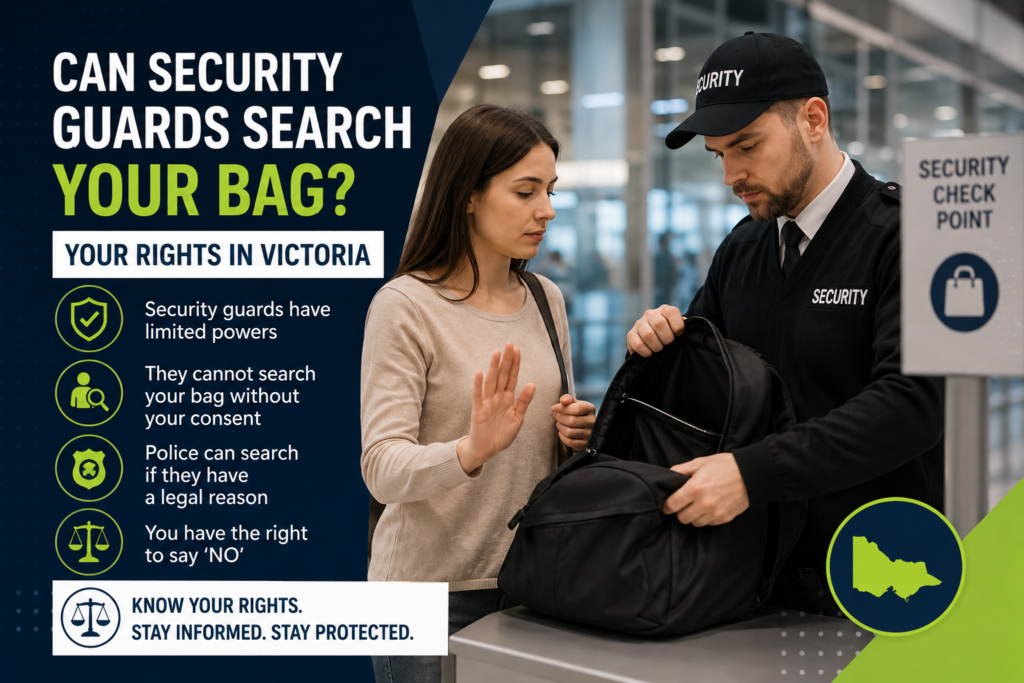
Numbers matter here too. A compliant bag check takes 10 to 20 seconds. It involves zero physical contact. It applies to every fifth patron or every patron, never to one person picked out by appearance, because the Equal Opportunity Act 2010 (Vic) makes discriminatory selection unlawful. Retailers who run checks must display signage at every entrance before you walk in, not at the exit as you leave.
This article answers what Victorian law says about bag searches, what signage and conditions of entry really do, what a guard may look at and what they must never touch, what happens when you refuse, how the rules change at festivals and licensed venues, how retail and shopping centre checks work, how staff bag checks differ, when a search becomes assault or false imprisonment, and how a licensed operator runs a check that stands up to scrutiny.
The short answer on consent
Consent is the entire legal basis for a bag check in Victoria. Say yes and the inspection is lawful. Say no and it stops. A guard cannot reach into a bag, unzip a compartment, or move items around unless you have agreed to it, and agreement given under threat is not agreement at all.
Victoria Legal Aid and its interstate equivalents put the position plainly for the public: guards ask, they do not compel. The only person who can force a search is a police officer acting under statutory power, and even police need reasonable grounds under the Drugs, Poisons and Controlled Substances Act 1981 (Vic) or a warrant. That gap between a licensed guard and a sworn officer is where most disputes begin, which is why the wording on a venue’s conditions of entry does so much work
What conditions of entry actually do
Conditions of entry create a contract, not a power. When a shopping centre, stadium or nightclub displays a sign saying bag inspection is a condition of admission, refusing that inspection breaches the condition. The venue’s remedy is to refuse you entry or ask you to leave. It is not to search you anyway.
That distinction gets misread constantly. A sign cannot manufacture a search power that Parliament never granted. What it does is shift the consequence of refusal from nothing to exclusion. Property occupiers control who enters private land under common law and the Summary Offences Act 1966 (Vic), so a venue can lawfully turn you away for declining. Once you are asked to leave and refuse, you become a trespasser and the guard can escort you out using force that is not disproportionate.
Signage has to be visible before the point of entry. A notice pinned behind a counter, or one you only see once you are already inside with a trolley, does not give informed agreement. Our crowd control team treats entry signage as part of the site brief for exactly this reason.
What a guard may look at, and what they must never touch
Looking is permitted. Touching is not. Once you open a bag and hold it out, the guard may look inside, ask you to lift a jacket so they can see beneath it, and ask you to open a zipped section. They may not put a hand in, rummage through contents, remove items, or empty the bag onto a table.
The rule set is consistent across Australian consumer guidance:
- Ask before every inspection, using a clear question rather than a gesture.
- Look only, keeping hands visible and away from the bag at all times.
- Request that the customer moves an item themselves if something is obscured.
- Stop the moment consent is withdrawn, even mid-inspection.
- Record the check in the incident log with time, location and outcome.
Physical searches of a person go further still. Pat-downs, searches under clothing, cavity searches and strip searches are all outside a guard’s authority in every Australian state. Frisking a patron at a festival gate without consent is an assault, regardless of what the wristband terms say. Where a venue genuinely needs that level of screening, the answer is police attendance or electronic detection, not a guard’s hands. Detection equipment brings its own question: what happens when someone simply refuses.
What happens if you refuse a bag check
Refusal carries consequences, but none of them involve being searched. The venue can deny entry, ask you to leave, or issue a banning notice covering a shop, a franchise group or an entire centre. Bans must not breach anti-discrimination law and cannot extend to public land.
Refusal can also change how a situation is read. Legal Aid guidance notes that declining a check on the way out of a shop may give staff extra reason to suspect concealment, which raises the risk of a citizen’s arrest attempt. That is a real risk, not a legal justification, and it cuts both ways. A guard who arrests on refusal alone, with no observed offence, is exposed to a false imprisonment claim. Refusal is not evidence. It is a choice the law protects.
Where entry screening is genuinely necessary, event operators plan for refusals in advance. Our event security guards work to a written entry protocol that names who makes the call, where the refusal is handled, and how the patron leaves without a confrontation at the gate.
Bag searches at events, festivals and licensed venues
Events run the tightest screening regimes in Victoria, and they run them on the same consent footing as everywhere else. Ticket terms and gate signage form the contract. Prohibited item lists cover glass, alcohol, weapons and unauthorised commercial equipment. Patrons who decline a check are refused admission and, depending on the promoter’s terms, may not receive a refund.
Licensed premises add another layer. The Liquor Control Reform Act 1998 (Vic) requires crowd controllers at many venues, and those crowd controllers hold a licence category above that of a general guard. They still cannot search a patron. What they can do is refuse entry, refuse service, and remove a person who is intoxicated, violent or trespassing.
Festival gates typically screen at a rate of one patron every 8 to 12 seconds per lane. That throughput only holds when the process is look-only and scripted. Adding physical contact slows lanes, provokes complaints, and creates liability the promoter carries. Retail environments face a different pressure, because the check happens on the way out rather than the way in.
Retail stores and shopping centres
Retail checks happen at the exit, which changes the psychology and nothing about the law. Store staff and contracted guards can request a look inside a bag if the store’s policy is displayed at the entrance. They cannot demand it, cannot touch contents, and cannot hold you while they decide.
Victoria’s retail sector loses significant stock to theft each year, and visible guarding is the standard response. Presence deters. Confrontation costs. A store that trains staff to ask politely, log refusals and call police when there is genuine evidence will lose less in litigation than one that trains staff to intercept. Our retail security guards and shopping centre teams work to observation-first procedures, with CCTV timestamps and written notes doing the evidentiary work.
Loss prevention evidence that holds up looks like this: a camera reference, a time, a description of what was seen, and the identity of the staff member who saw it. Not a bag emptied on a counter.
Staff bag checks under employment law
Employee checks sit on a separate footing again. An employer can require bag inspections as a term of employment where the enterprise agreement or contract provides for it, and where the practice is reasonable, consistently applied, and conducted with dignity. Even then, the employee opens the bag. The employer looks.
Fair Work decisions have repeatedly held that surveillance and search practices must be proportionate to the risk and clearly communicated in advance. A policy introduced without consultation, applied selectively, or run by a guard with no written authority is the practice most likely to end in a dispute. Warehouse and logistics clients using our asset protection services receive a documented check procedure that names the authorised checker, the frequency, and the escalation path.
When a bag search becomes assault or false imprisonment
Three lines get crossed most often. Touching a person without consent is assault. Touching or opening their property without consent is trespass to goods. Blocking their exit, standing in a doorway, or telling them they cannot leave until they comply is false imprisonment.
None of these require injury. The offence is complete on contact or confinement. A guard who grips a customer’s arm for four seconds has committed an assault even if nothing else happens, and the employing company carries vicarious liability alongside the individual. Under the Private Security Act 2004 (Vic), conduct of that kind also feeds into the Chief Commissioner’s assessment of whether a licence holder remains fit to hold a licence, with review available at VCAT.
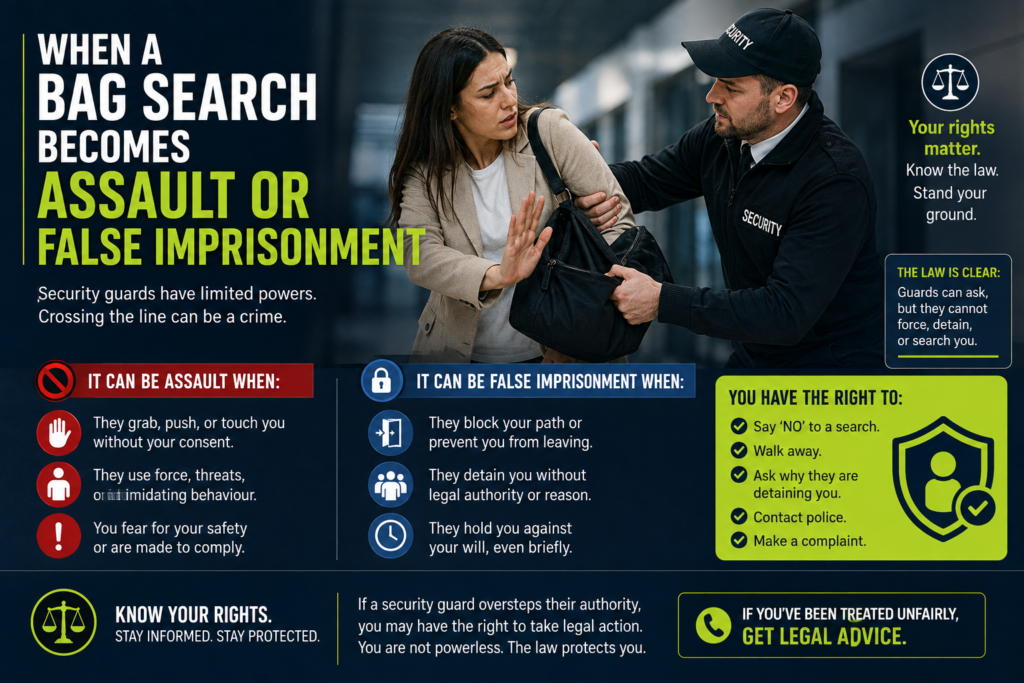
Reasonable force exists in Victorian law, but it attaches to arrest and to removal of trespassers, not to searching. Section 462A of the Crimes Act 1958 (Vic) permits force that is not disproportionate to the objective, and a bag inspection is never an objective that justifies force. That boundary between searching and detaining is the one guards are trained to hold.
How a compliant bag check runs
Compliant checks share a shape, and the shape is boring by design. Trained guards work a script, keep hands down, and log everything.
- Greet the person and state the reason for the check in one sentence.
- Ask permission using a direct question and wait for an answer.
- Observe the open bag from a comfortable distance without contact.
- Thank the person and let them proceed within 20 seconds.
- Log the interaction, including any refusal, before the next patron.
Guards delivering this hold current Victorian private security licences and complete CPP20218 Certificate II in Security Operations, which covers legal and ethical boundaries as core content. Walton Security guards work under ISO 9001, ISO 45001 and ISO 14001 certified systems, with written post orders for every site. Call 03 9970 8701 to discuss a screening protocol for your venue.
Frequently asked questions
Can a security guard search my bag without my permission in Victoria?
No. Consent is required for every bag inspection, and a guard has no statutory search power under the Private Security Act 2004 (Vic). Refusing is lawful. The venue’s only response is to refuse entry or ask you to leave.
Does a sign saying “bag checks are a condition of entry” change my rights?
The sign changes the consequence, not the power. Refusing still cannot be overridden, but the venue may lawfully deny you admission or ask you to leave because you have declined a term of entry. Signage must be displayed before the entrance to have any effect.
Can a security guard touch the contents of my bag?
No. Guards may look, not handle. If something blocks the view, the guard asks you to move it yourself. Reaching in, removing items or tipping a bag out is trespass to goods and may also amount to assault if contact is made with you.
What can a guard do if I refuse a bag check on the way out of a shop?
The guard can ask you to leave, refuse you future entry, issue a banning notice, or call police. What they cannot do is detain you for refusing, because refusal is not evidence of an offence and does not satisfy the arrest test.
Which security roles are allowed to screen bags at venues?
Crowd controllers and security guards licensed under the Private Security Act 2004 (Vic) both conduct entry screening. Neither category carries a search power. Crowd controllers hold the higher licence activity and work licensed premises under the Liquor Control Reform Act 1998 (Vic), while guards cover retail, corporate and construction sites.
Is a bag check different from a pat-down?
Yes, and the difference is decisive. A pat-down involves physical contact and is unlawful without consent, while a bag check is a visual inspection of property. No Australian security licence authorises frisking, searching under clothing, or strip searching a member of the public.
Can staff bag checks be required at work?
Yes, where the employment contract or enterprise agreement provides for it and the practice is reasonable. The employee opens the bag and the employer looks. Selective application, no prior notice, or physical handling of contents will each undermine the policy in a Fair Work dispute.
Do bag search rules change at music festivals?
The rules are identical, but the volume is higher. Ticket conditions and gate signage set the terms, and refusal means no admission, often with no refund. Police at festivals hold separate statutory powers that guards do not share.
Can a guard hold me while they wait for police?
Only if a lawful citizen’s arrest has been made under section 458 of the Crimes Act 1958 (Vic). Blocking your path without that basis is false imprisonment. The threshold is finding a person committing an offence, not suspicion arising from a declined bag check.
Can I be banned from a shopping centre for refusing?
Yes. Occupiers can issue written banning notices covering a single store, a franchise group or a whole centre. Bans cannot breach the Equal Opportunity Act 2010 (Vic) and cannot extend to public land or footpaths.
Should bag checks be random or apply to everyone?
Consistency protects the venue. Checking every patron or every nth patron removes the discrimination risk that selective checking creates. Selecting people by appearance, ethnicity or age exposes the operator to an Equal Opportunity claim.
What should I do if I think a guard went too far?
Record what happened while it is fresh, including time, location, guard name or licence number, and any witnesses. Complaints about licensed guards go to the Licensing and Regulation Division of Victoria Police, and serious conduct can also be reported to police or pursued as a civil claim.
Summary
Bag searches in Victoria run on consent, not authority. A licensed guard asks, looks, and stops when told to stop, because the Private Security Act 2004 (Vic) grants competency clearance rather than police search powers. Conditions of entry give a venue the right to refuse admission when you decline, and nothing more. Guards may look inside an opened bag but never handle contents, never pat down a person, and never block an exit without a lawful arrest under section 458 of the Crimes Act 1958 (Vic).
Events, licensed premises, retail floors and workplaces each apply the same consent rule with different signage and different timing. Compliant checks are scripted, contact-free, applied consistently, and logged. That is what keeps patrons safe and keeps operators out of assault, trespass and false imprisonment claims.
Walton Security designs entry screening protocols for Melbourne venues, retailers and event organisers, delivered by licensed guards under ISO certified systems. Call 03 9970 8701, email info@waltonsecurity.com.au, or request a free quote for your site.