
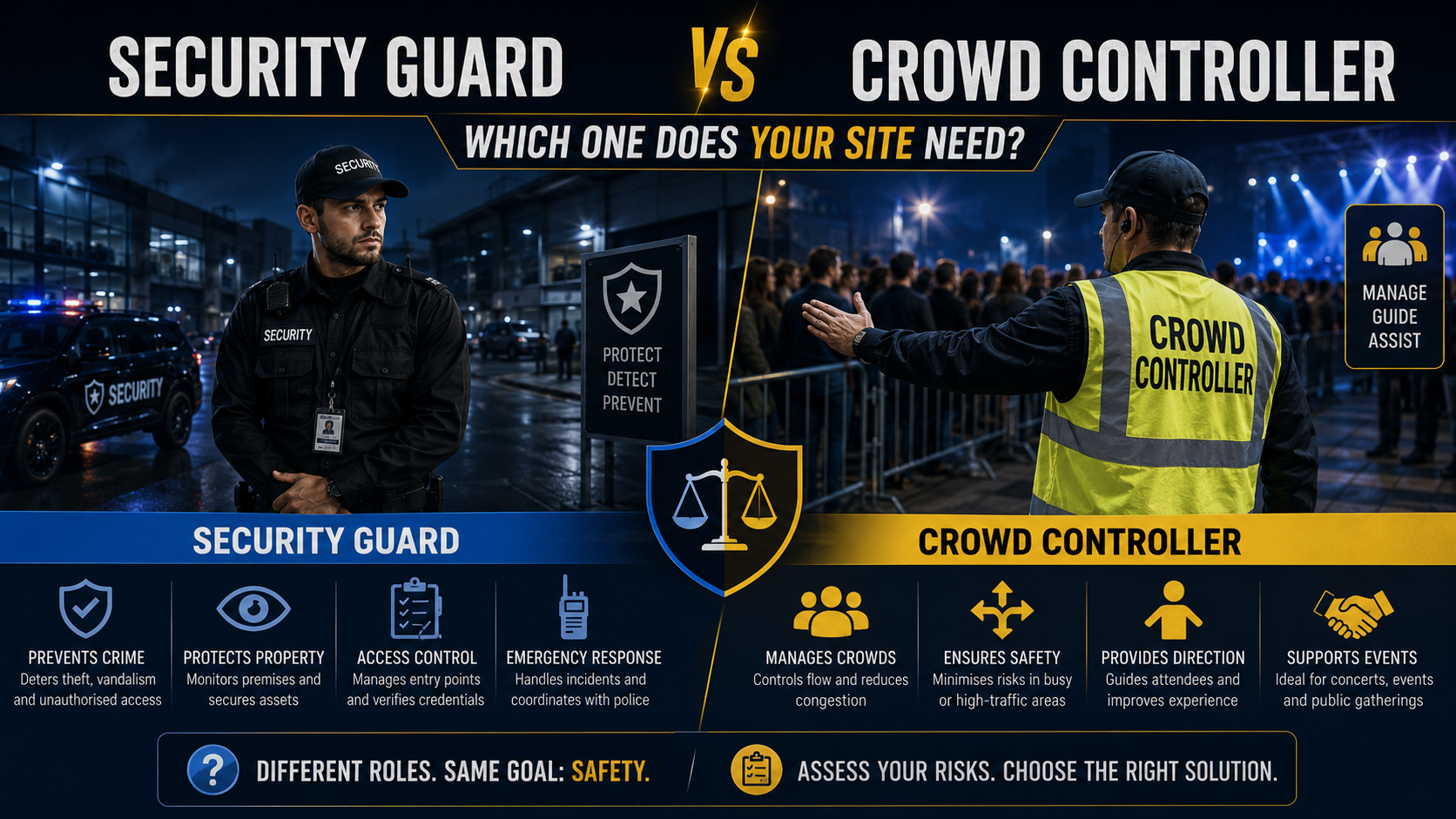
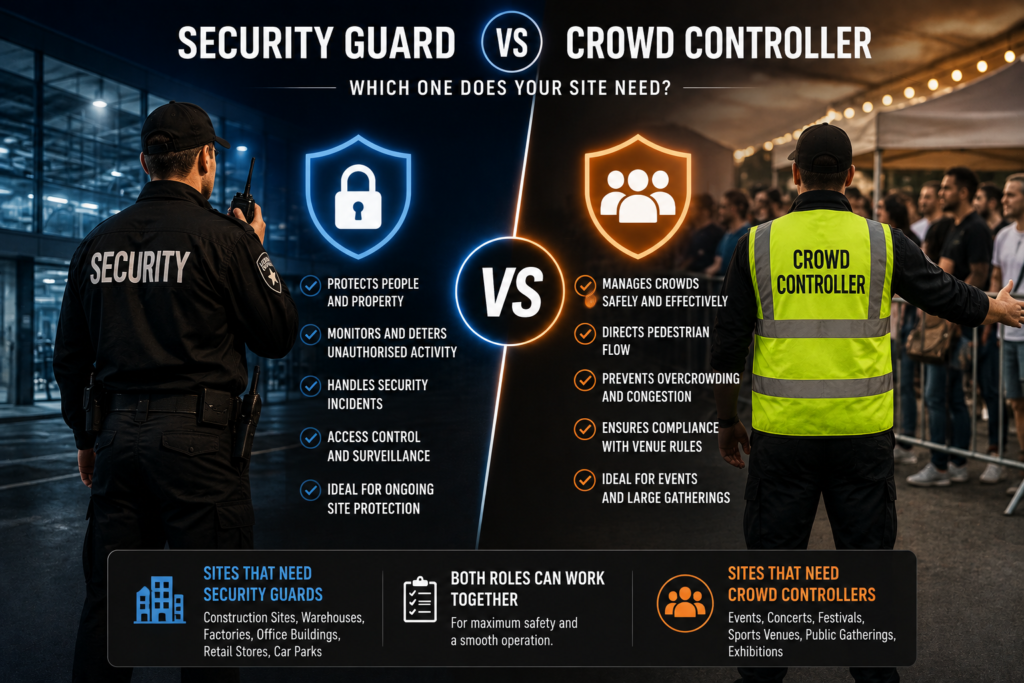
A security guard and a crowd controller are two separate licence activities under the Private Security Act 2004 (Vic), not two words for the same job. The guard activity covers protecting property, people and assets through static posts, patrols and access control. The crowd controller activity covers managing patrons at licensed premises and public events, including entry screening, queue management, refusal of entry and removal.
Both roles sit inside the same licensing framework administered by the Licensing and Regulation Division of Victoria Police, and both require CPP20218 Certificate II in Security Operations at 130 hours, which covers unarmed guard, crowd control and control room operator in one qualification. What differs is the endorsement printed on the licence, the legislation that governs the workplace, and the skill emphasis on the ground. A crowd controller at a licensed venue works under the Liquor Control Reform Act 1998 (Vic) as well as the security legislation. A guard on a construction site works under the Occupational Health and Safety Act 2004 (Vic) alongside it.
Cost follows the same award for both. The Security Services Industry Award 2020 (MA000016) sets a Level 1 base of $28.42 per hour from 1 July 2026, with casuals at $35.53, Sunday at double time and public holidays at two and a half times base. Crowd control shifts land disproportionately on Friday and Saturday nights, so the effective charge-out rate runs higher even when the classification is identical.
This article compares the licence activities, the training pathway, the day-to-day duties, the venues each role suits, the legal powers both share, the equipment and reporting differences, the cost picture, and how to decide which role your site actually needs.
Licence activities compared
Licence endorsement is the first practical difference. Every Victorian security worker holds a Private Security Individual Operator licence listing the activities they may perform, and the activity must match the work. A licence endorsed for security guard only does not authorise crowd control work at a licensed venue.
Security guard is the broader activity, with sub-activities covering unarmed guard, armed guard, control room operator and monitoring centre operator. Crowd controller stands as its own activity focused on patron management. Most working guards in Melbourne hold both endorsements because the Certificate II qualification supports both, which is why employers routinely ask for the combined ticket.
Businesses supplying either service need a matching Private Security Business licence, and since 19 December 2025 sole traders operating under an ABN need both a business and an individual operator licence under section 15A. Full detail sits in our guide to the Private Security Act 2004 (Vic). Training is where the two roles share the most ground.
Training and qualifications
Training runs through the same national qualification for both roles. CPP20218 Certificate II in Security Operations delivers 130 hours covering legal and ethical frameworks, communication and conflict de-escalation, crowd management strategies, emergency response and first aid content. Registered training organisations across Victoria deliver it, and Victoria Police approves the units.
Progression differs after entry. CPP31318 Certificate III in Security Operations at 112 hours supports armed guard work and senior or supervisory roles, and CPP31418 Certificate III in Close Protection Operations supports bodyguard licensing. Crowd controllers working licensed premises typically add responsible service of alcohol training, because refusing service and identifying intoxication form part of the venue’s obligations.
From 5 October 2026, both roles face the same renewal conditions: an approved first aid course for every individual operator licence, plus Victoria Police approved refresher training for anyone endorsed as security guard, crowd controller or bodyguard. Those requirements sharpen the practical distinction between the roles, which shows up most clearly in daily duties.
Day-to-day duties
Duties diverge sharply once the shift starts. A guard protects a place. A crowd controller manages a population.
Typical security guard duties include:
- Controlling access at gates, receptions and loading docks.
- Patrolling perimeters, stairwells, car parks and plant rooms.
- Responding to alarms and verifying causes before escalation.
- Logging incidents with time, location, action and outcome.
- Monitoring CCTV from a control room or on-site station.
Typical crowd controller duties include:
- Screening patrons at entry against age, dress and prohibited item rules.
- Managing queue flow and venue capacity against licence conditions.
- Identifying intoxicated or aggressive patrons before escalation.
- Refusing entry and removing patrons who become trespassers.
- Coordinating with venue management, promoters and police.
The common thread is observation and documentation. The difference is intensity and pace. A concierge guard may log four events across a 12 hour shift, while a crowd controller at a 2,000 capacity venue makes dozens of judgement calls between 10 pm and 3 am. That difference drives which role fits which site.
Where each role fits
Site type usually answers the question without much analysis. Fixed premises with assets, staff and controlled access need guards. Venues with patrons, alcohol and peak crowd loads need crowd controllers.
Guards suit warehouses, data centres, corporate offices, hospitals, schools, retail floors, residential towers and active construction sites. Walton Security supplies static and patrol guards to all of those categories through construction site security, office building security, retail security and concierge security.
Crowd controllers suit nightclubs, pubs, live music rooms, festivals, sporting fixtures, ticketed conferences and any event where entry is screened and capacity is capped. Our event security and crowd control teams cover Melbourne CBD venues, Southbank functions and regional festival sites.
Mixed sites exist and need both. A shopping centre runs guards through trading hours and adds crowd controllers for a late night trading event. A stadium runs crowd controllers at the gates and guards on the back of house doors. Legal powers stay identical across both, which surprises many clients.
Legal powers are identical
Neither role carries police powers. Both hold exactly the authority every Victorian holds under section 458 of the Crimes Act 1958 (Vic): the ability to arrest a person found committing an offence where reasonable grounds show arrest is necessary. Section 462A caps force at a level that is not disproportionate to the objective.
Neither a guard nor a crowd controller can search a person or their belongings without consent. Bag checks operate on consent supported by conditions of entry, covered in detail in can security guards search your bag. Neither can question a detained person, hold them beyond the transfer of custody to police, or use restraint equipment without the relevant licence activity and employer authorisation. Our guide to whether a security guard can detain you works through the arrest test in full.
What crowd controllers do carry is a venue-specific removal role. Patrons who refuse to leave licensed premises become trespassers under the Summary Offences Act 1966 (Vic), and reasonable force may be used to remove them. Guards hold the same removal role on the property they protect. The power is the occupier’s, exercised through the security personnel on duty.
Equipment, uniform and reporting
Equipment differences reflect the environment rather than the licence. Guards commonly carry a torch, radio, patrol scanning device, keys and a mobile reporting app. Crowd controllers carry a radio, torch and identification, and work in high visibility identification where venue rules or event conditions require it.
Body worn cameras appear in both roles and bring obligations under the Surveillance Devices Act 1999 (Vic) and the Privacy Act 1988 (Cth). Footage retention, access control and signage need documenting before deployment, not after an incident.
Reporting formats differ in rhythm. Guard reports run on patrol logs and shift summaries, with exception reporting for incidents. Crowd controller reports run on incident-by-incident records with time stamps that align to venue CCTV, because licensing complaints and liquor compliance reviews depend on that alignment. Both feed the same purpose: an evidence trail that stands up months later.
Cost comparison
Cost sits on the same award foundation for both roles. The Security Services Industry Award 2020 (MA000016) sets Level 1 at $28.42 per hour from 1 July 2026, Level 2 and above progressively higher, and casual loading at 25 per cent. Penalty rates apply to Saturdays, Sundays, public holidays and night work between 10 pm and 6 am.
Charge-out rates then add superannuation, workers compensation, insurance, supervision, training, uniform and margin. The reason crowd control quotes look higher is timing, not classification. Most crowd control hours fall on Friday and Saturday nights and public holidays, where penalty multipliers of double time and two and a half times base apply.
Two budgeting rules follow. First, compare quotes on the same days and hours, or the comparison means nothing. Second, treat a flat rate that does not change between a Tuesday day shift and a Sunday night shift as a warning sign, because award loadings are not optional. Our pricing model states the classification and the penalty basis in writing, and our hiring questions guide sets out what to ask any provider.
How to choose
Choose on risk profile, not on job title. Three questions resolve most decisions.
- Does the site hold assets, restricted areas or after-hours exposure? That points to guards.
- Does the site host patrons, alcohol service or capacity limits? That points to crowd controllers.
- Does the site do both at different hours? That points to a blended roster.
Walton Security runs a site assessment before quoting, reviewing entry points, peak hours, blind spots, incident history and licence conditions. The output is a written plan naming the role, the endorsement required, the hours and the reporting format, so nothing about the deployment is left to interpretation.
Frequently asked questions
What is the difference between a security guard and a crowd controller in Victoria?
They are separate licence activities under the Private Security Act 2004 (Vic). Security guards protect property, assets and people at fixed sites, while crowd controllers manage patrons at licensed premises and events, including entry screening, refusal of entry and removal.
Do crowd controllers need a different licence to security guards?
Yes, the licence must carry the crowd controller activity endorsement. A licence endorsed for security guard only does not authorise crowd control work. Most Melbourne guards hold both endorsements because CPP20218 supports each of them.
Do both roles need the same training?
Both start with CPP20218 Certificate II in Security Operations at 130 hours. The qualification covers unarmed guard, crowd control and control room operator together, with CPP31318 Certificate III at 112 hours available for armed guard and senior roles.
Which roles can work at a nightclub or licensed venue?
Crowd controllers. The Liquor Control Reform Act 1998 (Vic) governs licensed premises, and venues require crowd controllers for patron management. Guards may still work back of house posts, deliveries and asset protection at the same site.
Do crowd controllers have more legal power than guards?
No. Both hold identical powers under section 458 of the Crimes Act 1958 (Vic), the citizen’s arrest provision available to every person. Neither may search a person without consent or detain anyone outside a lawful arrest.
Which is more expensive to hire?
Crowd control usually costs more per shift, but not because of the classification. Penalty rates drive the difference, since most crowd control hours fall on Friday nights, Saturday nights and public holidays where the award applies double time and two and a half times base.
Can one person do both jobs on the same shift?
Yes, where the licence carries both endorsements and the roster is lawful. Activity endorsement is what matters, not the job title on the roster. Employers must still check the public register and match each person to the work performed.
Does a construction site need guards or crowd controllers?
Guards. Construction sites need access control, perimeter patrols and after-hours cover rather than patron management. Crowd controllers become relevant only where a site hosts a public event, such as a topping-out function or open day.
Do event organisers need both roles?
Larger events usually do. Crowd controllers cover gates, queues and patron areas, while guards cover equipment compounds, back of house, cash handling and overnight bump-in and bump-out periods.
What happens on 5 October 2026 for both roles?
Renewal conditions change for individual operator licences. An approved first aid course becomes mandatory for every holder, and Victoria Police approved refresher training applies to security guard, crowd controller and bodyguard activities.
How do I verify which activities a guard is licensed for?
Search the Register of Licence, Registration and Permit Holders by name or licence number. Licences issued from August 2025 show abbreviated activity titles on the card and the register, so match the abbreviation to the work being performed.
Can crowd controllers refuse entry without giving a reason?
Yes, subject to discrimination law. Occupiers control admission to private premises, and refusal must not breach the Equal Opportunity Act 2010 (Vic). Recording the reason in the incident log protects both the patron and the venue if a complaint follows.
Do security guards monitor CCTV or is that a separate role?
Monitoring falls under the control room operator and monitoring centre operator sub-activities of the security guard category. Those sub-activities must appear on the licence, and the qualification pathway differs from front-line guarding. Larger sites often split the roles across a control room operator and a patrolling officer.
Which role handles alarm response at night?
Security guards, usually through a mobile patrol contract. Alarm response involves attending, verifying the trigger and securing the site, which is property protection rather than patron management. Crowd controllers finish when the venue closes and patrons disperse.
Do the two roles wear different uniforms?
Uniform requirements come from the employer and the venue rather than the Act. Identification must be visible and licence cards carried on shift in both roles. Crowd controllers at licensed premises frequently wear high visibility identification because venue conditions or event permits require it.
Summary
Security guard and crowd controller are distinct licence activities under the Private Security Act 2004 (Vic), sharing one entry qualification in CPP20218 Certificate II in Security Operations and one arrest power under section 458 of the Crimes Act 1958 (Vic). Guards protect fixed premises through access control, patrols, alarm response and CCTV monitoring. Crowd controllers manage patrons at licensed premises and events through entry screening, capacity management, refusal of entry and removal.
Site type decides the choice. Warehouses, offices, hospitals, retail floors and construction sites need guards. Nightclubs, festivals, sporting fixtures and ticketed events need crowd controllers. Mixed venues need both across different hours. Costs sit on the same Security Services Industry Award 2020 foundation, with crowd control quotes running higher because the hours fall where penalty rates apply, and renewal conditions tighten for both activities from 5 October 2026.
Walton Security supplies licensed guards and crowd controllers across Melbourne and regional Victoria under ISO 9001, ISO 45001 and ISO 14001 certified systems. Call 03 9970 8701, email info@waltonsecurity.com.au, or book a free site assessment.