
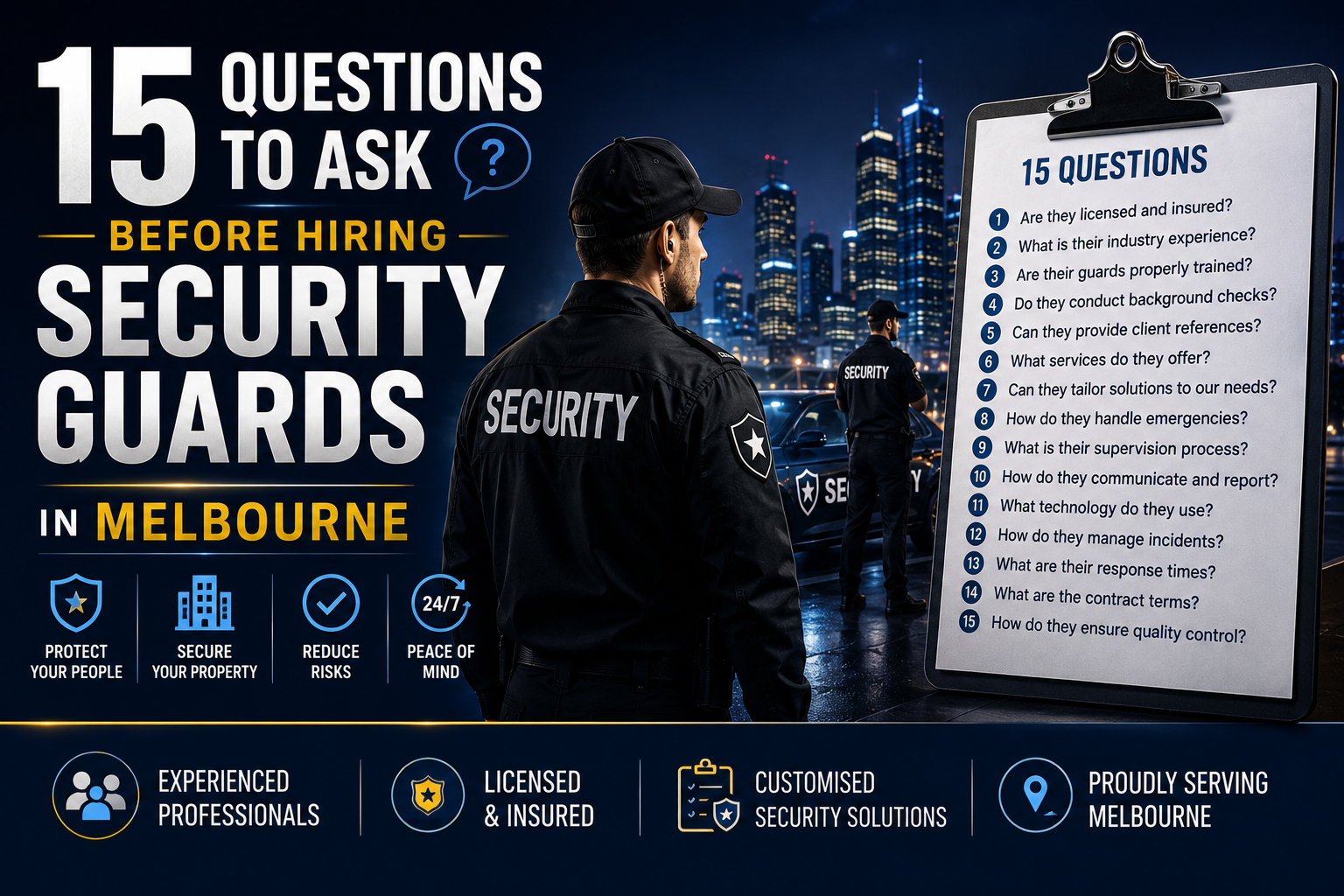
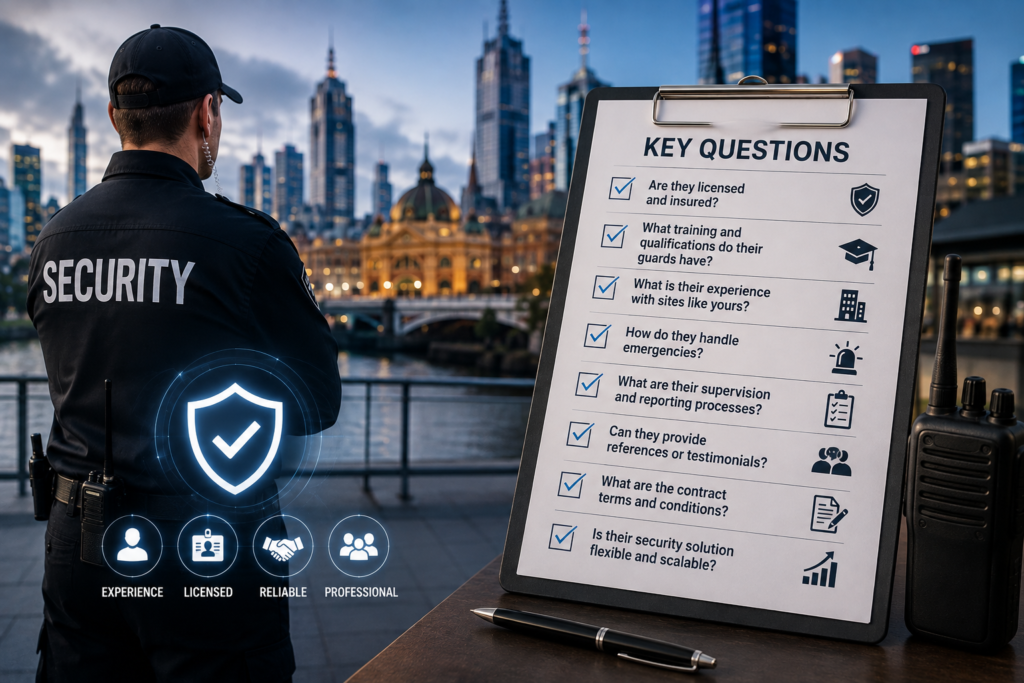
Hiring security guards is a procurement decision with legal consequences, and the questions asked before signing decide whether a business ends up with a documented service or an invoice with nobody accountable behind it. Every provider in Victoria operates under the Private Security Act 2004 (Vic), holds a Private Security Business licence issued through the Licensing and Regulation Division of Victoria Police, and rosters guards whose individual operator licences must carry the activity being performed.
Verification is fast. The Register of Licence, Registration and Permit Holders is searchable by name or licence number, certificates of currency for public liability and workers compensation arrive by email in a day, and any provider paying correctly under the Security Services Industry Award 2020 (MA000016) can state the classification behind their rate without hesitation. Level 1 sits at $28.42 per hour base from 1 July 2026, casuals at $35.53, Sundays at double time and public holidays at two and a half times base.
The questions that reveal the most are rarely about price. They cover supervision frequency, incident reporting format, escalation contacts after midnight, replacement procedure when a guard calls in sick, and how licence renewals are tracked ahead of the 5 October 2026 first aid and refresher training requirements. Providers who answer those precisely tend to be the providers whose guards turn up.
This article works through licensing and insurance questions, cost and award questions, staffing and supervision questions, site-specific planning questions, reporting and technology questions, contract and exit questions, the warning signs worth walking away from, and a short pre-signature checklist.
Licensing and compliance questions
Licensing is the first filter and takes minutes to check. Ask for the Private Security Business licence number and search it on the public register before anything else.
- What is your Private Security Business licence number?
- Which activities is the business licensed for, and do they match our requirement?
- Will every rostered guard hold an individual operator licence with matching endorsements?
- How do you track licence expiry and renewal across your workforce?
- How are you preparing for the 5 October 2026 first aid and refresher training conditions?
Suspended, cancelled and expired authorities do not appear on the register, so an absent search result is a stop signal rather than an administrative glitch. Licences issued from August 2025 display abbreviated activity titles on the card and the register, which catches out clients expecting the older wording. The full framework is set out in our guide to the Private Security Act 2004 (Vic). Insurance is the natural next question.
Insurance and liability questions
Insurance answers the question nobody asks until an incident happens. Request documents, not assurances.
Ask for certificates of currency covering public liability and workers compensation, and check the expiry dates rather than the letterhead. Ask what the public liability limit is, and whether it is adequate for the site type, because a construction yard and a boutique retail store carry different exposure profiles.
Then ask about conduct. Who carries responsibility if a guard uses force during a removal or makes an unlawful detention? A provider who understands section 458 of the Crimes Act 1958 (Vic) will explain their training and escalation protocol rather than deflecting. Background on those limits sits in can a security guard detain you.
One duty stays with you regardless. Under the Occupational Health and Safety Act 2004 (Vic), the occupier owes safety obligations to contractors on site, covering lighting, safe access, lone worker arrangements and emergency procedures.
Cost and award questions
Pricing questions expose underpayment risk faster than any other line of enquiry, and underpayment predicts turnover.
- Which award classification level applies to the guards on our site?
- Does the quoted rate include penalty rates for nights, weekends and public holidays?
- What is the minimum shift length and the callout minimum for alarm response?
- Are travel, uniform, equipment and reporting included, or billed separately?
- How much notice applies before a rate increase, and what triggers one?
A flat hourly rate that never changes between a Tuesday day shift and a Sunday night shift cannot be paying award loadings, since Sunday attracts double time and public holidays two and a half times base under MA000016. Either the guards are underpaid, which produces churn and unlicensed substitutions, or the provider is pricing at a loss. The cost structures behind each model are compared in in-house vs contracted security guards.
Staffing and continuity questions
Continuity is what clients actually buy, and it lives in the roster rather than the contract.
Ask how many guards the provider employs, how many are casual, and what the pool looks like for your suburb. Ask specifically: what happens when a guard calls in sick at 5 am for a 6 am start? The answer should describe a dispatch process with a named coordinator, not a hope.
Ask whether you will get named regular guards. Site familiarity is worth more than most clients realise, because a guard who knows which contractor belongs on level three catches the one who does not. Then ask about turnover across the last 12 months. High churn means constant reinduction and inconsistent reporting.
Specialist cover deserves its own question. Events, licensed premises and executive protection each need specific endorsements, and the distinctions are covered in security guard vs crowd controller.
Supervision and quality control questions
Supervision separates a service from a warm body. Without it, post orders drift within weeks.
Ask how often a field supervisor attends site, whether attendance is documented, and who reviews incident reports for quality. Ask whether checkpoint scanning is used to verify patrols actually occurred, and whether you receive that data or only a summary.
Ask about certification. ISO 9001 quality management, ISO 45001 occupational health and safety, and ISO 14001 environmental management indicate audited systems rather than informal habits. Walton Security holds all three and runs active supervision, real-time reporting and monthly coverage reviews as standard.
Then ask the direct question: can you show me last month’s incident log and patrol records for a comparable site, with client details removed? A provider with functioning supervision produces that within a day.
Site-specific planning questions
Generic quotes signal generic service. A provider who quotes before seeing the site is guessing at the risk.
- Will you conduct a site assessment before quoting, and what does it cover?
- Will we receive written post orders naming duties, patrol timing and positions?
- How is the guard role defined for our specific entry points and blind spots?
- What is the escalation path after midnight, and who answers?
- How often will the plan be reviewed as our site changes?
A proper assessment reviews entry and exit points, peak hours, incident history, parking and perimeter access, and produces a plan that matches risk to hours rather than selling a fixed package. Our risk assessment process documents each of those elements before a quote is issued, and construction clients receive phase-specific plans through construction site security.
Reporting and technology questions
Reporting is the deliverable you can audit, so define it before the first shift rather than after the first incident.
Ask what a shift report contains, how quickly incident reports arrive, and whether reporting is app-based with timestamps or handwritten and retyped. Ask whether you get a client portal, an email summary, or both.
Technology questions follow. Does the provider supply body worn cameras, and if so what is the policy on recording, retention and access? Cameras attract obligations under the Surveillance Devices Act 1999 (Vic) and the Privacy Act 1988 (Cth), and those need documenting before deployment. If the site also uses CCTV, ask how monitoring and patrol reporting integrate, a question explored in mobile patrols vs CCTV monitoring.
Contract and exit questions
Contract terms decide how easily you can leave if the service slips, which is exactly why they deserve attention while everyone is still enthusiastic.
Ask about the minimum term, the notice period for termination, and whether there is a trial period. Ask what happens to pricing if hours reduce, and whether standing the service down between project phases attracts a fee.
Ask about subcontracting. Some providers subcontract shifts to third parties, which breaks the licence verification chain and the supervision model you just agreed. If subcontracting is permitted, require notification and licence details for any subcontracted personnel.
Finally, ask for two client references from comparable Melbourne sites, and call them. Ask those referees one question that matters: what happened the last time something went wrong?
Warning signs worth acting on
Some answers should end the conversation rather than prompt a follow-up.
- Refusing to supply a business licence number or insurance certificates.
- Quoting a flat rate identical across weekdays, Sundays and public holidays.
- Quoting without a site visit for anything beyond a single short shift.
- Describing guards as holding police-equivalent powers of search or detention.
- Offering rates far below the award-based floor for the hours requested.
The fourth item is worth dwelling on. Guards hold no search power and no arrest power beyond section 458 of the Crimes Act 1958 (Vic), as explained in can security guards search your bag. A provider who claims otherwise will train guards who overstep, and the incident lands on your premises.
Pre-signature checklist
Run these five verifications before signing anything.
- Search the business licence number on the public register and confirm the activities.
- Obtain and date-check public liability and workers compensation certificates.
- Get the award classification and penalty basis for the quoted rate in writing.
- Confirm the written post orders, reporting format and after-hours escalation contact.
- Call two references from comparable sites and ask about incident handling.
Walton Security supplies all five as standard, with licence numbers, certificates, written plans and reporting samples provided during the quoting process rather than after commencement.
Frequently asked questions
How do I check whether a security company is licensed in Victoria?
Search the Register of Licence, Registration and Permit Holders by business name or licence number. Suspended, cancelled and expired authorities do not appear, so treat an empty result as a reason to stop rather than an error.
What insurance should a security provider carry?
Public liability and workers compensation at minimum, evidenced by current certificates of currency. Check the expiry dates and the liability limit against your site’s exposure, and require annual refresh of both documents.
How much do security guards cost in Melbourne?
Charge-out rates build on the Security Services Industry Award 2020, where Level 1 base is $28.42 per hour from 1 July 2026 and casuals $35.53. Final rates depend on hours, penalty loadings, site risk, guard classification and whether patrols or alarm response are included.
Why does the same guard cost more on a Sunday?
Award penalty rates. Sunday work attracts double time and public holidays two and a half times base under MA000016, so a provider quoting an identical rate across all days is not applying the award correctly.
Should a provider visit my site before quoting?
Yes, for anything beyond a single short shift. A site assessment identifies entry points, blind spots, peak hours and incident history, and produces a plan matching guard hours to actual risk instead of a generic package.
What should written post orders contain?
Duties, positions, patrol timing, access control rules, incident reporting requirements and escalation steps. Post orders are the document that makes performance measurable, and their absence is the most common reason a security contract underdelivers.
How often should a supervisor visit site?
Frequency depends on shift volume, but visits should be documented and unannounced at least in part. Checkpoint scanning verifies patrols occurred, and incident report review confirms quality rather than mere completion.
What happens if a guard does not turn up?
A capable provider dispatches a replacement from a rostered pool with a named coordinator managing it. Ask for the specific process and response time rather than a general assurance, and confirm what credit applies for unstaffed hours.
Can a security company subcontract my site to another firm?
Only if the contract permits it. Subcontracting breaks the licence verification and supervision chain you agreed, so require prior notification and licence details for any subcontracted personnel, or exclude it entirely.
Do I need guards or crowd controllers for my event?
Larger events need both. Crowd controllers manage gates, queues and patron areas under the Liquor Control Reform Act 1998 (Vic) where alcohol is served, while guards cover equipment compounds, back of house and overnight bump-in periods.
What certifications indicate a well-run security company?
ISO 9001 for quality management, ISO 45001 for occupational health and safety, and ISO 14001 for environmental management. These certifications indicate audited systems, alongside membership of industry bodies and a current Private Security Business licence.
What questions reveal an underperforming provider fastest?
Ask for last month’s incident log and patrol records for a comparable site. A provider with working supervision produces both within a day, while one relying on unsupervised shifts will delay, summarise verbally, or explain why records are unavailable.
Should I ask about guard training beyond the licence?
Yes. CPP20218 Certificate II in Security Operations is the entry qualification, not the finish line. Ask about de-escalation refreshers, first aid currency, site inductions and emergency drills, all of which become sharper requirements at renewal from 5 October 2026.
How long should a security contract run?
Match the term to the requirement, with a trial period for new relationships. Project sites suit phase-based agreements, while permanent premises often use 12 month terms with defined notice periods and a documented review schedule.
Summary
Hiring security guards in Melbourne comes down to verification rather than persuasion. Confirm the Private Security Business licence on the public register, confirm the individual operator endorsements match the work, and obtain current public liability and workers compensation certificates before any conversation about price. Then get the award classification and penalty basis behind the quote in writing, because a rate that ignores Sunday double time and public holiday loadings under the Security Services Industry Award 2020 signals underpayment and turnover.
Continuity, supervision and reporting decide whether the service holds up after month three. Ask about the replacement process at 5 am, the field supervision schedule, checkpoint verification, incident report timing and the after-hours escalation contact. Insist on a site assessment before quoting and written post orders before commencement, and check contract terms covering notice, trial periods and subcontracting while the relationship is still new.
Walton Security answers every question on this list during quoting, supported by current Victorian private security licences and ISO 9001, ISO 45001 and ISO 14001 certification. Call 03 9970 8701, email info@waltonsecurity.com.au, visit 163/585 Little Collins Street, Melbourne VIC 3000, or request a free site assessment and quote.