
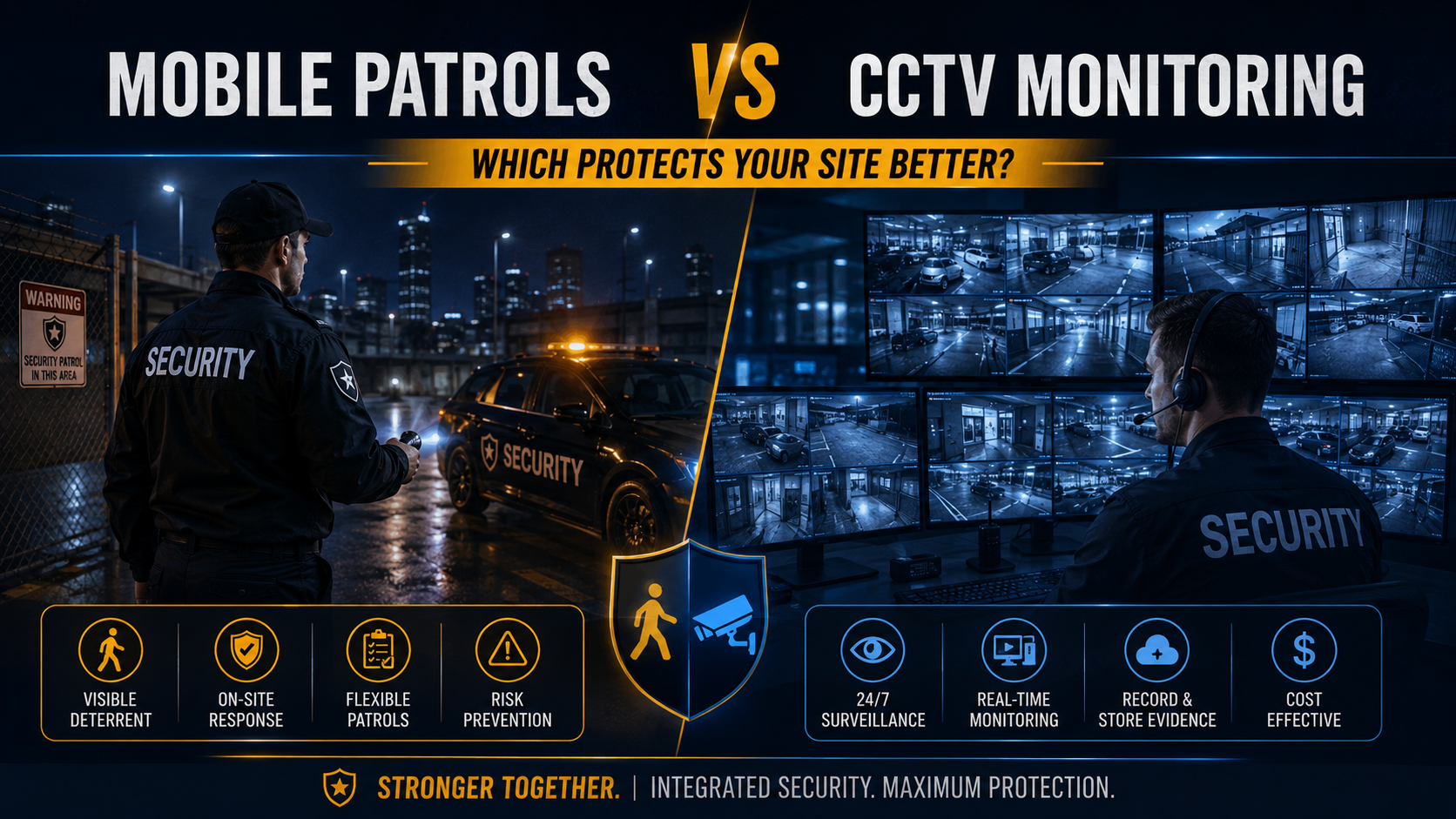
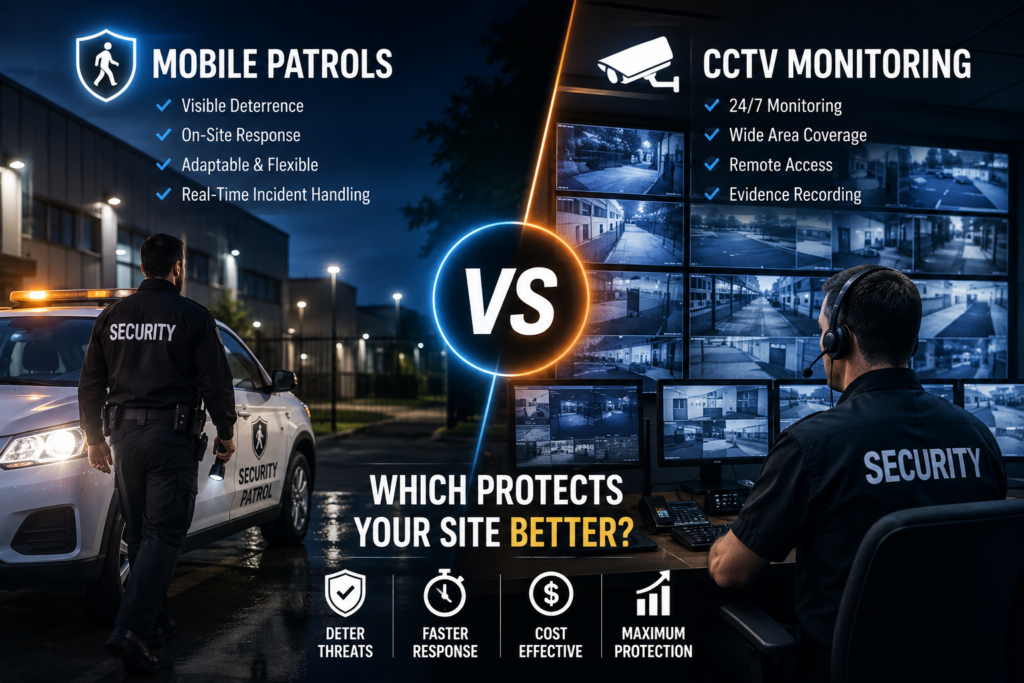
Mobile patrols (scheduled and randomised vehicle inspections of a site by a licensed guard) and CCTV monitoring (continuous remote surveillance of camera feeds by a control room operator) solve the same problem from opposite directions. Patrols deliver physical presence at intervals. Monitoring delivers continuous vision without presence. Neither replaces the other, and choosing between them without understanding that trade-off is how sites end up paying for coverage they do not get.
The measurable differences are stark. A patrol officer covering a site every 90 minutes provides roughly 8 to 12 physical checks across a 12 hour overnight period, each lasting 10 to 20 minutes, which means most of the night has no one on site. A monitored camera array watches every zone continuously, and a trained operator can review a motion alert and issue an audio challenge within seconds. What the camera cannot do is unlock a gate, escort a contractor, check a fire door from the inside, or physically stop anything.
Cost splits along the same line. Patrols run on labour under the Security Services Industry Award 2020 (MA000016), where the Level 1 base sits at $28.42 per hour from 1 July 2026 and casuals at $35.53, before penalty rates of double time on Sundays. Monitoring runs on capital plus a flat monthly monitoring fee, which scales better across large or multi-zone sites. Both sit under Victorian law: the Private Security Act 2004 (Vic) licenses the people, and the Surveillance Devices Act 1999 (Vic) and Privacy Act 1988 (Cth) govern the footage.
This article compares detection speed, coverage, response capability, evidence quality, deterrence, cost structure, privacy obligations, site suitability, and the hybrid model most Melbourne operators end up using.
How mobile patrols work
Patrols work on movement and unpredictability. A licensed guard arrives by vehicle, walks the perimeter, checks doors, gates, lighting, plant rooms and car parks, scans checkpoints to prove attendance, and logs findings before moving to the next site.
Randomised timing is the core of the method. Fixed schedules teach intruders the gap, so patrol windows shift shift by shift. Typical frequency runs between two and six visits per night depending on risk, with each visit lasting 10 to 20 minutes. Alarm response bolts onto the same service, with an officer dispatched to verify a trigger rather than the client attending at 3 am.
The output that clients actually buy is the report. Time of arrival, checkpoints scanned, faults found, action taken. Our mobile security patrols deliver that after every shift, which is what makes patrols auditable in a way that a drive-past never is. Cameras produce a different kind of record.
How CCTV monitoring works
Monitoring works on continuous vision plus human verification. Cameras cover defined zones, analytics flag motion, line crossing, loitering or vehicle entry, and an operator in a control room reviews the alert and decides what happens next.
Response options include issuing an audio challenge through site speakers, calling a patrol officer to attend, notifying the client, or calling police with a live description. Verified alarm activations get police attention faster than unverified ones, because someone has confirmed what is happening rather than relaying a sensor trip.
Control room and monitoring centre operator work is licensed under the Private Security Act 2004 (Vic) as a sub-activity of the security guard category. Cameras alone are not a security service. A recorded feed nobody watches produces evidence after the loss, not prevention before it, which is the distinction that matters most in detection speed.
Detection and response speed
Speed splits the two models cleanly. Monitoring detects in seconds. Patrols detect on arrival.
An operator receiving an analytics alert can review the feed and confirm or dismiss it within about 5 to 15 seconds, then issue an audio warning shortly after. Most opportunistic intruders leave at that point, because being addressed by name and description removes the assumption of anonymity. A patrol officer, by contrast, may be 20 minutes away on another site when the same event happens, and the event may be complete before anyone arrives.
Response reverses the advantage. Only the officer can physically secure a broken gate, escort a person off site, meet police, or make a citizen’s arrest under section 458 of the Crimes Act 1958 (Vic). An operator watching a theft in progress can do nothing physical about it. That is why detection and response are best measured as two separate metrics rather than one.
Coverage and blind spots
Coverage favours cameras on large sites. A single camera array with eight to twelve views can hold an entire yard under continuous observation, while one officer sees roughly what a torch beam reaches and only where they are standing.
Patrols cover what cameras cannot see. Interior spaces, locked rooms, roof access, tampered locks, water leaks, unsecured windows and unauthorised vehicles all show up on a physical walk and stay invisible to a fixed lens. Sites with heavy plant, shifting stockpiles or changing layouts, such as active construction, generate camera blind spots weekly as the site changes shape.
Both models degrade for predictable reasons. Cameras lose value to poor placement, glare, dead network links and unmonitored recording. Patrols lose value to fixed timing, skipped checkpoints and unreported faults. Checkpoint scanning fixes the second problem, and regular camera audits fix the first. What neither fixes automatically is evidence quality.
Evidence quality
Evidence favours cameras when the footage is properly retained. Continuous recording with accurate timestamps produces a sequence a court can follow, and analytics make retrieval fast rather than a manual scrub through hours of video.
Patrol reports produce a different evidence type: contemporaneous observation by a licensed witness. A guard who records a registration plate, a description and a time creates a statement that carries weight, and the guard can be called to give evidence. Insurers value both, and many policies require documented after-hours checks as a condition.
The strongest evidence packages combine them. Camera footage establishes what happened. The patrol report establishes site condition before and after, who attended, and what was done. Retail and warehouse clients using our asset protection services receive both in the same incident file.
Deterrence
Deterrence differs in kind. Cameras deter people who believe they are being watched. Physical presence deters people who see a vehicle, a uniform and a torch.
Signage does real work for both. Camera signage is a legal requirement in many contexts and a deterrent in all of them. Patrol signage on fences and gates tells opportunists the site is checked, and the marked vehicle reinforces it during each visit. Combined signage outperforms either alone.
The honest limitation is that determined offenders defeat both. Organised theft crews study patrol patterns and disable cameras. The realistic goal is displacement and detection, not prevention of every event, and that reality shapes how the budget should be split.
Cost structure compared
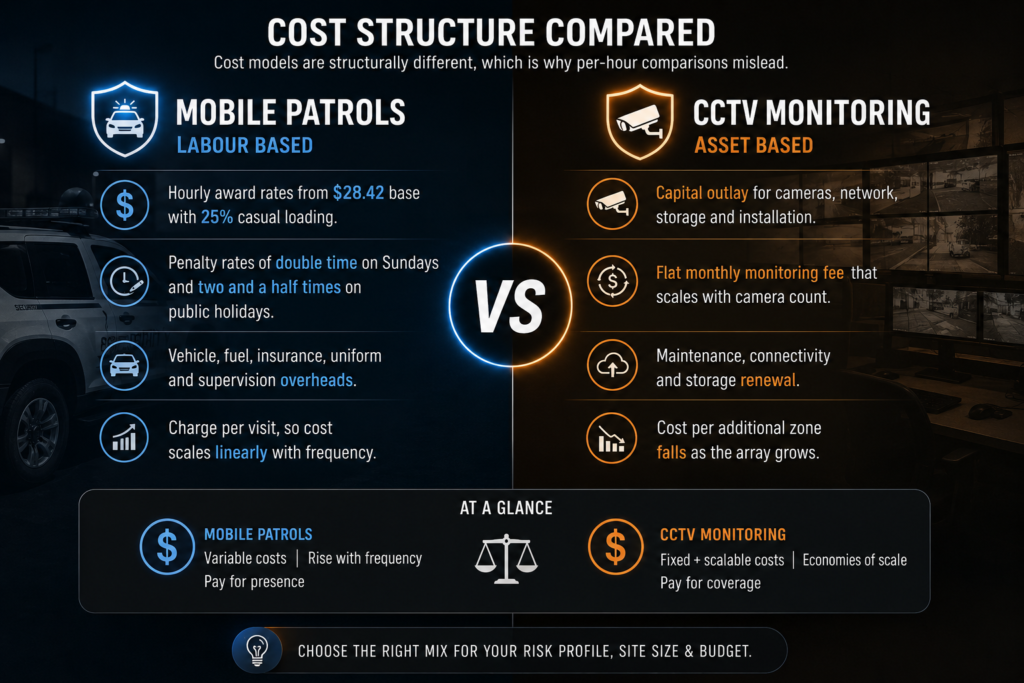
Cost models are structurally different, which is why per-hour comparisons mislead.
Mobile patrol costs are labour based:
- Hourly award rates from $28.42 base with 25 per cent casual loading.
- Penalty rates of double time on Sundays and two and a half times on public holidays.
- Vehicle, fuel, insurance, uniform and supervision overheads.
- Charge per visit, so cost scales linearly with frequency.
CCTV monitoring costs are asset based:
- Capital outlay for cameras, network, storage and installation.
- Flat monthly monitoring fee that scales with camera count.
- Maintenance, connectivity and storage renewal.
- Cost per additional zone falls as the array grows.
The pattern that follows is predictable. Small sites with a single entry point often get more value per dollar from patrols. Large yards, multi-building campuses and long perimeters usually get more coverage per dollar from monitoring. High-risk sites needing both detection and physical intervention need both services, budgeted separately. Legal obligations then attach to the camera half of that budget.
Privacy and surveillance law in Victoria
Cameras attract obligations that patrols do not. The Surveillance Devices Act 1999 (Vic) restricts the use of optical surveillance devices to record private activity without consent, and the Privacy Act 1988 (Cth) with the Australian Privacy Principles governs how footage of identifiable people is collected, stored, used and disclosed by covered organisations.
Practical compliance looks like this: signage at every entry point stating cameras are in use, cameras aimed at the client’s own property rather than neighbouring premises or public footpaths, documented retention periods, restricted access to footage, and a written process for disclosure requests. Workplace monitoring adds consultation obligations under the Occupational Health and Safety Act 2004 (Vic) where cameras cover staff areas.
Body worn cameras on patrol officers sit under the same rules. Audio recording is treated more strictly than vision, and policies need to state when recording starts, when it stops, and who may access the file. Getting this documented before deployment avoids the complaint that arrives after the first incident.
Which model suits which site
Site characteristics decide the answer more reliably than budget alone.
- Choose patrols for small commercial sites, strata buildings, retail strips, vacant properties and after-hours alarm response.
- Choose monitoring for large yards, long perimeters, multi-zone campuses and sites with continuous overnight exposure.
- Choose both for construction sites, logistics hubs, car dealerships and any site with a theft history.
Construction is the clearest case for the blended model. Perimeters are long, layouts change weekly, plant and copper are high value targets, and Australia’s construction sector loses an estimated $1.5 billion to theft each year. Cameras hold the yard continuously while patrol officers verify gates, escort deliveries and respond to alerts, which is how our construction site security contracts are structured.
The hybrid model
Hybrid deployment assigns each tool to what it does best. Cameras take continuous perimeter and yard coverage. Officers take access points, interior checks, alarm verification and anything requiring a decision or physical action.
A working overnight structure for a mid-size site looks like this: continuous monitoring from 6 pm to 6 am, three randomised patrol visits across the same window, audio challenge on first alert, patrol dispatch on confirmed intrusion, and police notification with live description where an offence is in progress. Reporting consolidates into one file each morning.
Walton Security builds that split during a site assessment that reviews entry points, blind spots, peak risk hours and incident history, then documents the guard role, patrol timing, camera zones and escalation steps before deployment. Our night security and mobile patrol teams work to the same written post orders under ISO 9001, ISO 45001 and ISO 14001 certified systems.
Frequently asked questions
Is CCTV monitoring cheaper than mobile patrols?
Usually per hour of coverage, yes. Monitoring runs on a flat monthly fee plus capital, while patrols run on award hourly rates from $28.42 base with penalty loadings. The saving grows with site size because extra camera zones cost far less than extra patrol hours.
Can CCTV replace security guards entirely?
No. Cameras detect but cannot intervene physically. Unlocking gates, escorting people, meeting police, checking interiors and making an arrest under section 458 of the Crimes Act 1958 (Vic) all require a person on site.
How often should mobile patrols visit a site?
Two to six visits per night suits most commercial sites, with each visit running 10 to 20 minutes. Randomised timing matters more than raw frequency, because fixed schedules teach offenders exactly when the site is empty.
How fast does a monitored camera system respond?
An operator typically reviews an analytics alert within 5 to 15 seconds. Audio challenge follows within about 30 seconds on sites fitted with speakers, and patrol dispatch or police notification follows where the intrusion is confirmed.
Do recorded cameras count as monitoring?
No. Recording captures evidence, monitoring enables response. A recorded-only system delivers footage after the loss, while monitoring puts a licensed control room operator on the feed in real time under the Private Security Act 2004 (Vic).
What privacy laws apply to CCTV in Victoria?
The Surveillance Devices Act 1999 (Vic) and the Privacy Act 1988 (Cth) both apply. Signage, camera aim, retention periods and access controls need documenting, and cameras must not record private activity on neighbouring property or capture public areas beyond what is necessary.
Which is better for construction sites?
A blend of both. Long perimeters and weekly layout changes create camera blind spots, while high value plant and copper need physical verification. Continuous camera coverage with randomised patrol visits produces the strongest result.
Do patrols work for vacant properties?
Yes, and they are often the only practical option. Vacant sites rarely have power or network for a camera array, so scheduled visits with checkpoint scanning and written reports provide the audit trail insurers ask for.
Does CCTV footage help with police reports?
Substantially. Timestamped footage lets police identify the sequence and the offender, and verified activations receive faster attention than unverified alarm calls. Patrol reports add witness detail that footage alone cannot supply.
How long should CCTV footage be retained?
Retention should match the operational need and be stated in writing, commonly 30 to 90 days for commercial sites. The retention period must be documented and applied consistently, since indefinite storage of identifiable footage creates privacy exposure.
Can one provider supply both services?
Yes, and a single provider simplifies escalation. One incident file, one contact and one escalation path removes the delay that occurs when a monitoring company and a patrol company report separately.
Which model suits a strata or apartment building?
Patrols plus targeted cameras usually fit best. Common areas, car parks and bin rooms benefit from camera coverage, while patrol officers handle after-hours noise, unauthorised access and resident escalations that no camera can resolve.
Summary
Mobile patrols and CCTV monitoring answer different halves of the same problem. Monitoring provides continuous vision, detection within seconds and evidence with accurate timestamps, and it scales efficiently across large yards and long perimeters. Patrols provide physical presence, interior checks, alarm verification, escorting and the ability to act under section 458 of the Crimes Act 1958 (Vic), with cost tied to labour under the Security Services Industry Award 2020.
Coverage, response speed, evidence quality, deterrence and cost structure all pull in different directions, and Victorian privacy obligations under the Surveillance Devices Act 1999 and the Privacy Act 1988 apply to the camera half of any deployment. Small sites often suit patrols alone, large multi-zone sites often suit monitoring, and construction, logistics and high-risk premises need the hybrid model where cameras hold the perimeter and officers handle everything requiring a decision.
Walton Security assesses your site, splits the coverage between the two models, and documents patrol timing, camera zones and escalation in writing. Call 03 9970 8701, email info@waltonsecurity.com.au, or request a free site assessment.