
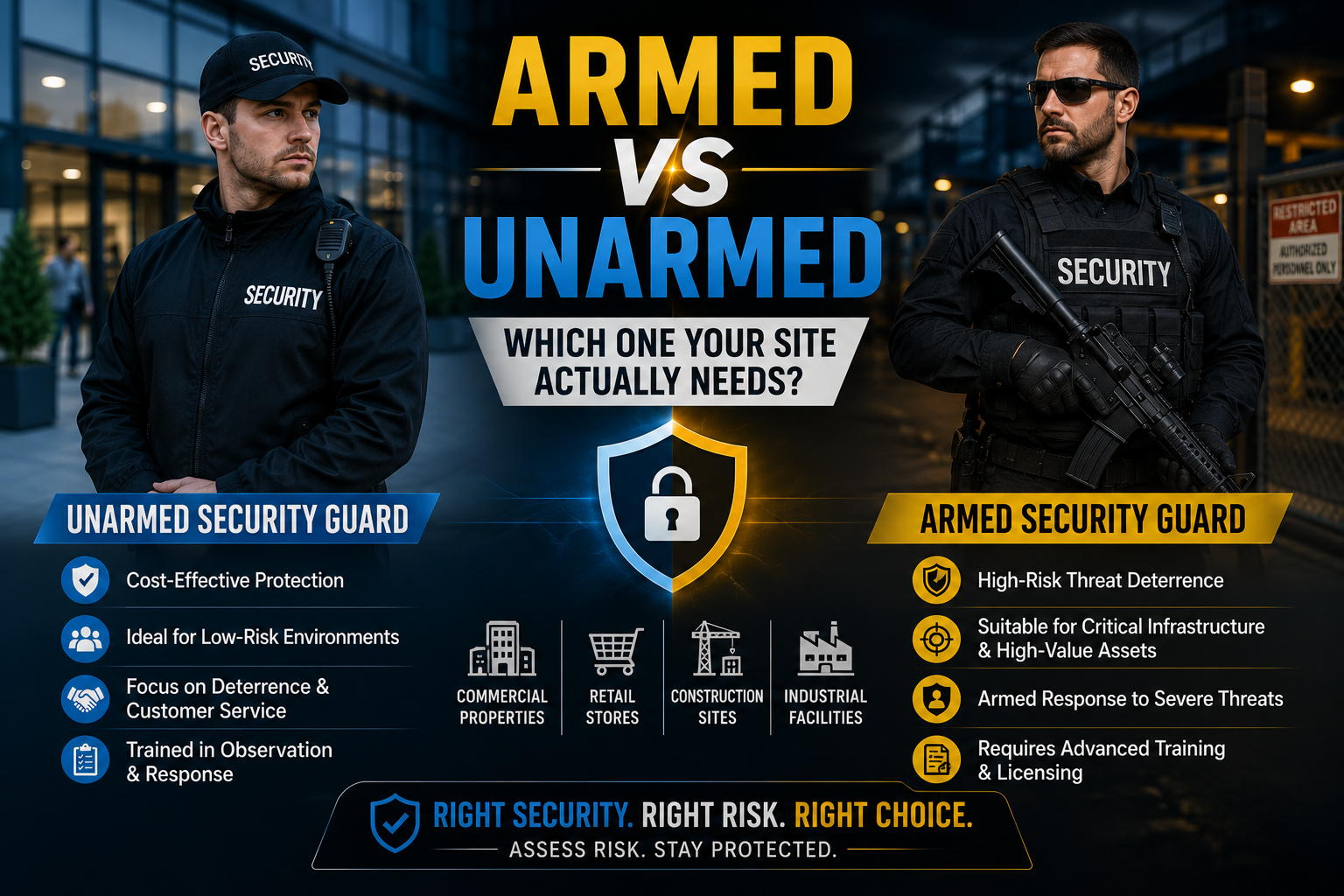
Armed security guards carry a firearm and a Category H weapons licence; unarmed security guards protect through presence, observation, and de-escalation without a weapon. In Melbourne, unarmed guards handle roughly 95% of all private security work, and Victorian licensing law blocks armed deployment for standard commercial sites. So for most Melbourne businesses the practical choice is not “which is stronger” but “does my site legally and operationally justify a weapon at all.” This guide explains where each guard type fits, what Victorian law allows, what each costs, and how to match the model to your site’s actual risk.
Below you’ll find the core difference between the two, the Victorian firearms rules that decide eligibility, the licensing each guard must hold, a site-by-site recommendation table, real cost expectations, a plain risk-assessment checklist, and answers to the questions Melbourne site managers ask most.
The Core Difference Between Armed and Unarmed Guards
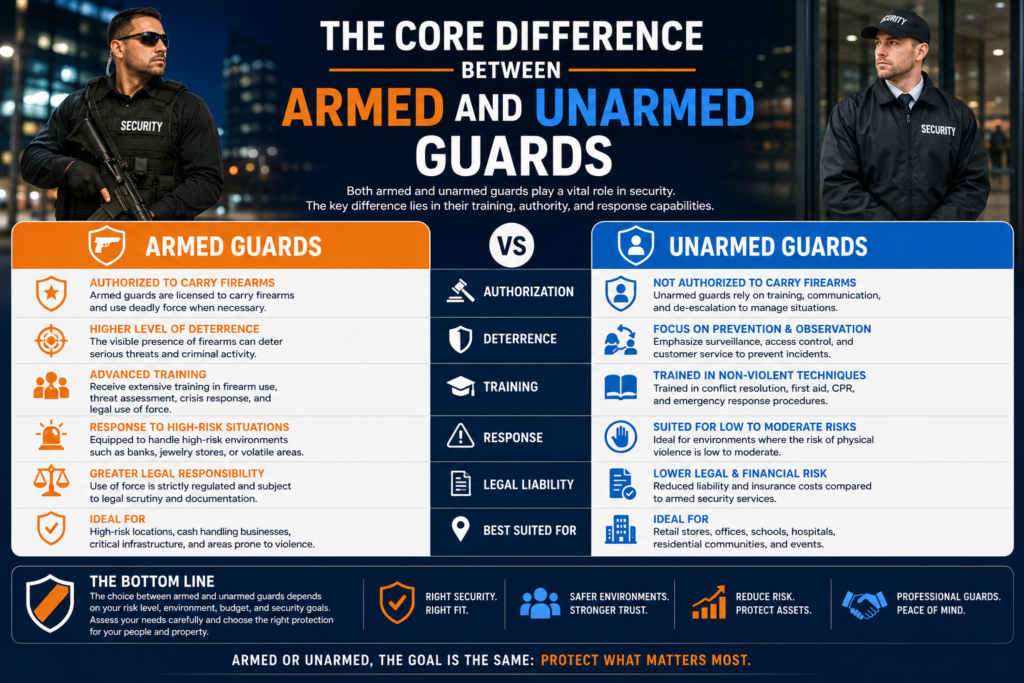
An unarmed guard prevents incidents. An armed guard responds to a narrow band of threats that a weapon is genuinely needed to stop. That single distinction drives everything else, from training hours to hourly rate.
Unarmed security guards deter crime through visible uniformed presence, control access points, monitor CCTV and alarms, patrol perimeters, log incidents, calm verbal disputes, and call police or emergency services when a situation escalates beyond their remit. Their whole model reduces the need for force before force is ever required.
Armed security guards do all of the above, plus they carry a firearm for situations involving a credible risk of serious violence, robbery, or armed confrontation. They train in weapon handling, threat assessment, and the legal boundaries of using a weapon on duty. Their deployment is tightly restricted and expensive, so it maps to a short list of high-risk work rather than everyday guarding.
Here is the difference at a glance:
| Feature | Unarmed Guard | Armed Guard |
| Weapon carried | None | Firearm (plus baton where endorsed) |
| Primary role | Prevention, observation, reporting | Threat response, high-value asset protection |
| Suitable sites | Most commercial and residential sites | Cash-in-transit, high-risk specialist roles |
| Licence required | Victorian Private Security Individual Licence (unarmed) | Above plus Category H firearm licence and armed business licence |
| Relative cost | Standard | Significantly higher |
| Deterrent style | Approachable, low-friction | Overt, high-intensity |
Armed Guards Are Rare in Victoria, and the Law Is Why
Victoria enforces strict firearms regulation, and that regulation reaches directly into the security industry. Armed guarding is not a service a business can simply request and pay a premium for. Licensing authorities restrict it to a defined set of high-risk operations, and Victoria Police supervises the firearms side closely.
The roles that genuinely qualify for armed security in Melbourne are narrow: cash-in-transit and armoured vehicle transport, government buildings and diplomatic premises, and specialist close-protection work for at-risk individuals. Retail stores, shopping centres, construction sites, events, corporate offices, and residential buildings do not qualify. A business seeking an armed guard for a standard commercial purpose will find the request declined at the licensing stage, not the quoting stage.
This is what separates Melbourne from jurisdictions where armed guards stand outside ordinary shops. Here the default is unarmed, the exception is armed, and the exception has to be justified by the nature of the work rather than a preference for a heavier presence. For around 99% of Melbourne businesses, a licensed unarmed guard is the correct and compliant answer.
Licensing: What Each Guard Type Must Legally Hold
Both guard types are licensed. The armed pathway simply adds a firearms layer on top of the standard security qualification, and that layer is where most of the extra cost and scarcity comes from.
An unarmed security guard working in Melbourne must hold:
- A Victorian Private Security Individual Licence in the unarmed guard category, issued under Victoria Police regulation
- Certificate II in Security Operations
- Current First Aid and CPR certification
- A national police background check
- A Working With Children Check where the site involves minors, such as schools or family events
An armed security guard must hold everything above and then add:
- A Category H firearm licence, the class covering handguns
- Documented, ongoing firearms training and requalification
- Employment by a security business that itself holds a specific armed guard business licence
That last point matters. An individual cannot freelance as an armed guard in Victoria; the employing company needs its own armed endorsement, which few providers carry.
Why Unarmed Guards Are So Effective Without a Weapon
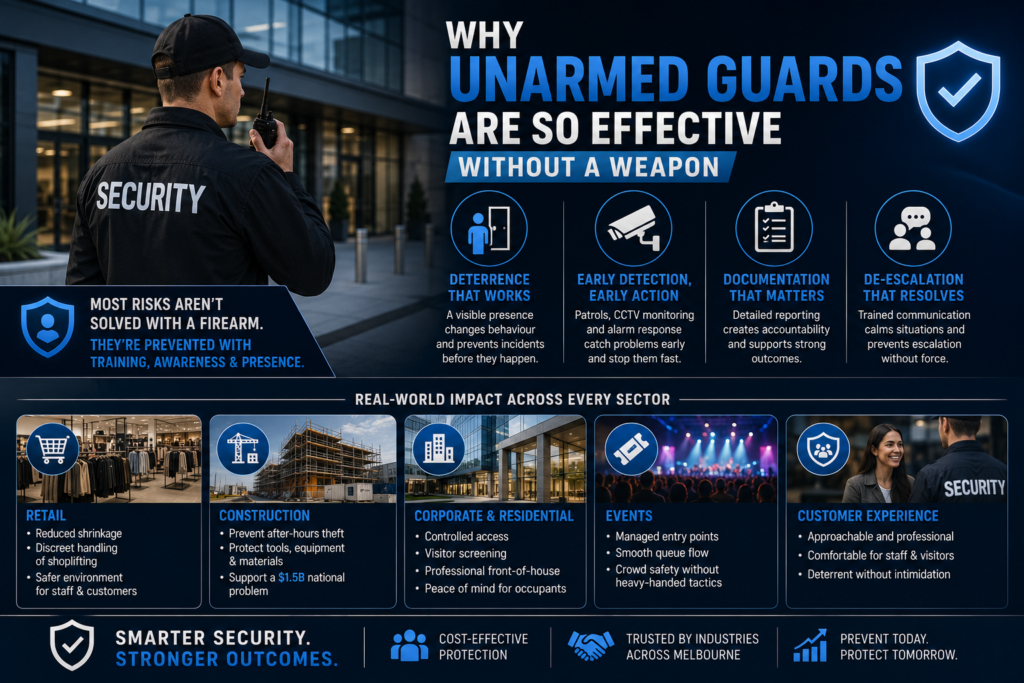
There’s a persistent myth that a guard without a firearm is a guard without teeth. Melbourne’s incident data and everyday commercial experience say the opposite. A well-trained unarmed officer prevents far more than a weapon ever resolves, because most site risks are theft, trespass, anti-social behaviour, and access failures, not armed confrontation.
Unarmed guards work through four capabilities that cover the vast majority of real-world situations. They control who enters and leaves through access management and visitor screening. They watch for problems early through patrols, CCTV monitoring, and alarm response. They document everything with time-stamped, actionable incident reports. And they defuse tension through trained verbal de-escalation before it becomes physical. A uniformed guard at the door changes behaviour on its own, which is deterrence doing the work so that force never has to.
For retail, this shows up as reduced shrinkage and discreetly handled shoplifting. For construction, it shows up as stopped after-hours theft on a national problem that costs the sector an estimated $1.5 billion a year. For corporate and residential sites, it shows up as controlled entry, screened visitors, and a calm, professional front-of-house. For events, it shows up as managed entry points, smooth queue flow, and crowds kept safe without heavy-handed intervention. None of it needs a firearm, and in customer-facing settings an approachable unarmed presence often works better than an intimidating one, because it keeps staff and visitors comfortable while still deterring the people who shouldn’t be there.
Which Guard Type Is Right for Your Melbourne Site
Matching the guard to the site is a risk decision, not a strength contest. The table below reflects how Melbourne sites are actually staffed under Victorian licensing.
| Your Site Type | Recommended Guard Type |
| Retail store or shopping centre | Unarmed guard |
| Construction site | Unarmed guard or mobile patrol |
| Corporate office building | Concierge-style unarmed guard |
| Residential tower | Unarmed concierge or static guard |
| Event or festival | Unarmed guards and crowd controllers |
| School, university, or hospital | Unarmed guard with Working With Children Check |
| Large-scale cash handling or transit | Armed security (specialist providers only) |
The pattern is clear. Almost every mainstream commercial and community site is an unarmed site. Armed security enters the picture only when the work itself involves moving or holding large volumes of cash or comparable high-value assets, and even then it runs through specialist licensed operators under close supervision.
The unarmed services that cover these site types include event security and crowd control for gatherings, construction site protection, retail loss prevention, asset protection for warehouses and data centres, mobile patrol officers for perimeters and car parks, and concierge security for corporate and residential towers. Each is delivered by licensed unarmed guards rather than armed personnel.
What Armed and Unarmed Security Cost in Melbourne
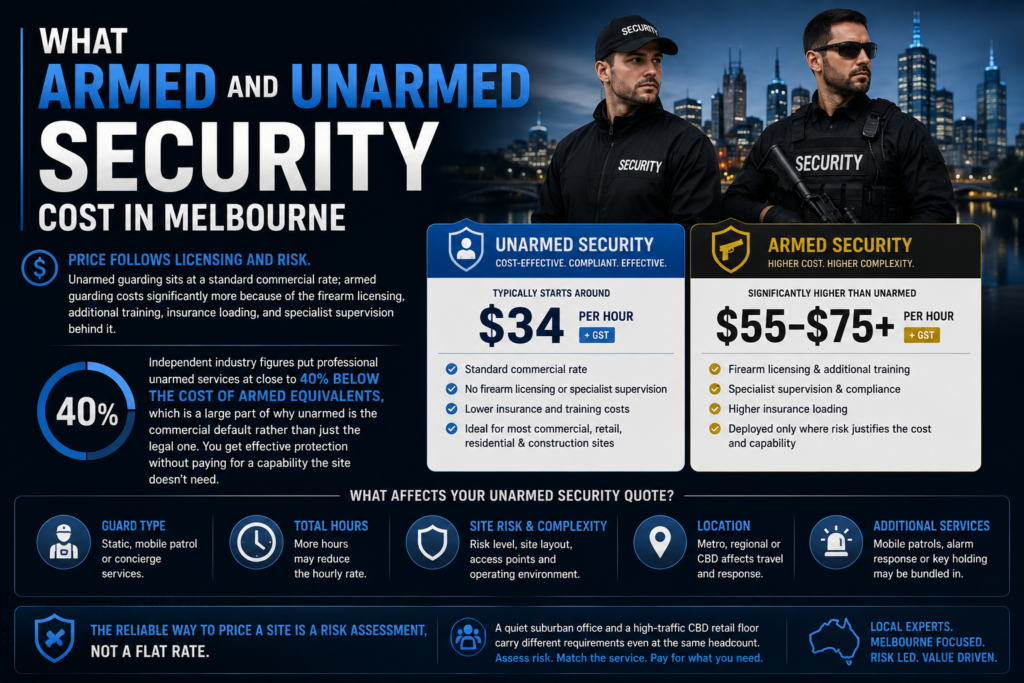
Price follows licensing and risk. Unarmed guarding sits at a standard commercial rate; armed guarding costs significantly more because of the firearm licensing, additional training, insurance loading, and specialist supervision behind it.
As a Melbourne benchmark, unarmed security typically starts around $34 per hour plus GST, moving up with site size, location, hours, and duty complexity. Independent industry figures put professional unarmed services at close to 40% below the cost of armed equivalents, which is a large part of why unarmed is the commercial default rather than just the legal one. You get effective protection without paying for a capability the site doesn’t need.
Several things move an unarmed quote: the guard type (static, mobile, or concierge), total hours, the site’s risk profile and complexity, and whether mobile patrols or alarm response are bundled in. The reliable way to price a site is a risk assessment rather than a flat rate, because a quiet suburban office and a high-traffic CBD retail floor carry different requirements even at the same headcount.
Do You Actually Need Armed Security? A Simple Risk Check
Before assuming a weapon equals more safety, run your site through three questions. They cut straight to whether armed security is legally and practically warranted.
- Does your business handle large volumes of physical cash, jewellery, or comparable high-value inventory on a regular basis?
- Is there a known, credible risk of violent robbery or armed confrontation specific to your operation?
- Do you require armed escorts or armed cash-transit protection as a core part of the work?
Answer no to all three and unarmed security is your correct solution, both under Victorian law and on the numbers. Answer yes and you’re likely in cash-in-transit or a specialist high-risk category that needs a licensed armed provider. For the overwhelming majority of Melbourne sites, this checklist lands firmly on unarmed, which is exactly what the licensing framework is built to produce.
The goal is to match protection to genuine need, so you get real safety without unnecessary cost or complexity. Overbuying a weapon you can’t legally deploy on a standard site helps nobody; a properly trained, well-supervised unarmed guard on a plan built for your risk does.
Are security guards armed in Melbourne?
Very rarely. Unarmed is the norm across Melbourne, and armed security is restricted to high-risk specialist work such as cash-in-transit and close protection. Armed guards need dual licensing, a security licence plus a Category H firearm licence, and operate under Victoria Police supervision. For standard retail, event, construction, corporate, and residential sites, guards are unarmed.
Is an unarmed guard less safe than an armed guard?
No, not for the sites unarmed guards protect. Most commercial risk is theft, trespass, and anti-social behaviour, which prevention, visibility, and de-escalation handle better than a weapon. A trained unarmed guard deters incidents before they start and escalates to police when needed. Armed guards aren’t “safer” in general; they’re specialised for a narrow set of high-risk roles.
Can I hire an armed guard for my retail store or office in Melbourne?
No. Victorian licensing does not permit armed guards for standard commercial sites such as retail stores, offices, shopping centres, or construction sites. Requests for armed security in these settings are declined at the licensing stage. A licensed unarmed guard is the compliant and effective option, and it covers the loss prevention, access control, and safety these sites need.
What licence does a security guard need in Victoria?
An unarmed guard needs a Victorian Private Security Individual Licence in the unarmed category, plus Certificate II in Security Operations, current First Aid and CPR, and a police background check. Sites involving children also require a Working With Children Check. Armed guards additionally need a Category H firearm licence and must work for a company holding an armed guard business licence.
How much do unarmed security guards cost in Melbourne?
Unarmed security typically starts around $34 per hour plus GST, with the final rate depending on guard type, hours, site risk, and whether patrols or alarm response are included. That runs roughly 40% below armed equivalents. The most accurate price comes from a free site assessment rather than a flat quote, since requirements vary between a quiet office and a busy CBD retail floor.
When is armed security actually necessary?
Armed security is warranted only when the work involves regularly handling large volumes of cash or high-value assets, a credible risk of violent or armed confrontation, or armed transit and escort duties. That means cash-in-transit, armoured transport, government and diplomatic premises, and specialist close protection. Outside those categories, Victorian law and commercial practice both point to unarmed guards.
Can you hire armed guards from a standard Melbourne security company?
Not for standard commercial work. Most Melbourne security companies provide licensed unarmed guarding, covering event security, crowd control, construction, retail, asset protection, mobile patrols, and concierge services. Armed guarding is confined to specialist operators holding an armed business licence, and it applies only to cash-in-transit and other high-risk categories. For the vast majority of sites, unarmed guarding is the service on offer and the one that fits.
How do I decide between armed and unarmed for my site?
Run the three-question risk check: large-scale cash or high-value assets, a known risk of armed confrontation, and a need for armed escorts. No to all three means unarmed is right for you, which covers almost every Melbourne site. Yes to any means you’re in specialist armed territory. A professional site risk assessment confirms the model and the coverage plan your site actually needs.
The Practical Takeaway
For almost every Melbourne site, the decision resolves to a licensed unarmed guard, matched to the specific risk through a proper assessment rather than a preference for a heavier presence. Armed security stays reserved for the narrow, tightly regulated categories the law defines. If you’re weighing the unarmed options for your site, the individual services, from event security and mobile patrols to construction and retail protection, are set out on Walton Security’s service pages.