Event Security: Definition, Meaning, Duties, Solutions, Audit, Management

Crowd control is a specialised security function focused on managing groups of people to ensure public safety, maintain order, and prevent incidents at events, licensed venues, and public spaces. Victorian guidance on crowd management at events establishes frameworks for safety planning that protect attendees while enabling smooth operations. Licensed crowd controllers use situational awareness, effective communication, and proactive planning to guide crowd movement, manage entry and exit points, and respond to incidents before they escalate into dangerous situations.

Crowd control security guards operate across diverse environments including concerts, festivals, sports events, nightclubs, shopping centres, and construction sites with public access. Their core duties encompass managing entry and exits, controlling queues, maintaining capacity limits, conducting screening and bag checks, monitoring crowd behaviour, and coordinating emergency evacuations. Essential equipment including crowd control barriers, radios, CCTV cameras, and metal detectors supports these functions while surveillance systems enable real-time monitoring of crowd dynamics.

This comprehensive guide examines crowd control duties, equipment, procedures, and management practices for Victorian event organisers and venue operators. Understanding crowd management techniques, legal requirements under the Private Security Act 2004, and the benefits of professional crowd control enables informed decisions about protecting public safety while meeting compliance obligations.

What Is Event Security?

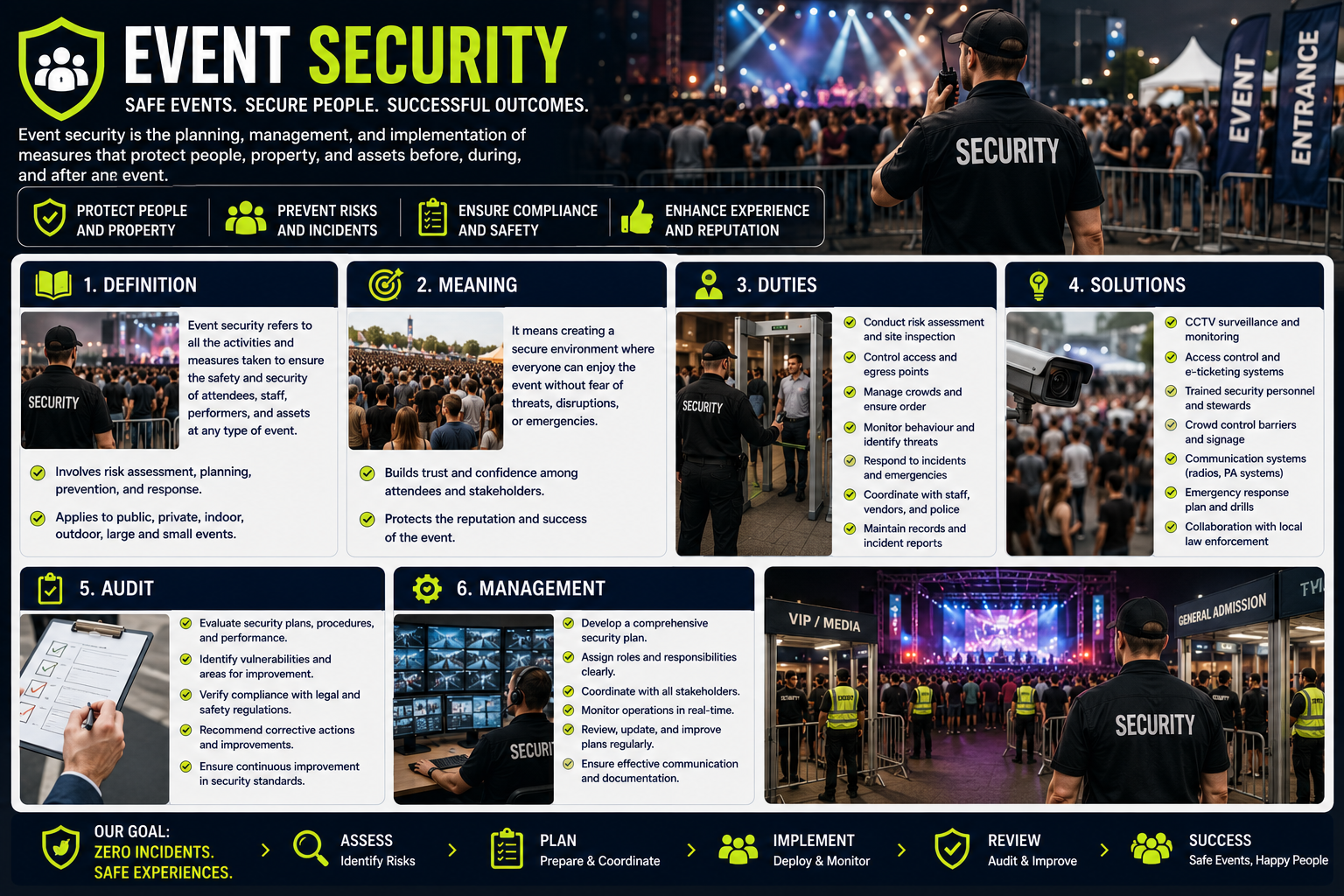
Event security encompasses all protective services, procedures, and personnel assigned to safeguard people and property at organised gatherings. Security teams work to prevent unauthorised entry, detect suspicious behaviour, manage crowd flow, respond to emergencies, and enforce venue rules throughout the event lifecycle. The purpose extends beyond mere physical protection to include creating an atmosphere where attendees feel safe and can enjoy the experience without concern.

Professional event security services begin with pre-event risk assessment, where security coordinators evaluate the venue layout, identify potential threats, and develop customised security strategies. This planning phase involves reviewing site maps, establishing access routes, positioning checkpoint perimeters, and determining staffing needs based on expected attendance figures. Security personnel receive detailed briefings covering their specific roles, communication protocols, and emergency procedures before guests arrive.

During the event, security guards maintain visible deterrence while conducting venue patrols, monitoring surveillance systems, managing access points, and responding promptly to incidents. After the event concludes, the security team ensures safe dispersal, secures the venue, completes incident reports, and participates in debriefing sessions to capture lessons learned. This comprehensive approach establishes event security as an ongoing process rather than a single-point intervention.

Why Is Event Security Critical for Modern Public and Private Events?

Event security is critical because trained security guards prevent harm, disorder, and financial losses through visible deterrence, controlled access management, and calm crowd control techniques. Modern public and private events face elevated risks from large crowds, alcohol consumption, unauthorised entry attempts, theft, property damage, and incidents that can escalate rapidly without professional intervention. Security personnel reduce safety risks, operational disruptions, and potential liability exposure for organisers.

Public gatherings create environments where diverse groups interact in confined spaces, often with limited visibility and competing interests. Research on crowd behaviour at mass gatherings demonstrates that proactive security presence significantly reduces the likelihood of conflicts, injuries, and panic situations. Professional guards trained in crowd psychology can identify warning signs before situations deteriorate, allowing for intervention at early stages when de-escalation remains possible.

Event security also supports organisers in meeting their duty of care obligations, enforcing venue rules, and maintaining compliance with local regulations. Security presence protects the organiser’s reputation by ensuring attendees have positive experiences free from safety concerns. From the moment guests approach entry points until they exit the venue, professional security teams manage the safety chain that determines whether an event succeeds or encounters problems that could have been prevented.

What Are the Main Duties and Responsibilities of Event Security Guards?

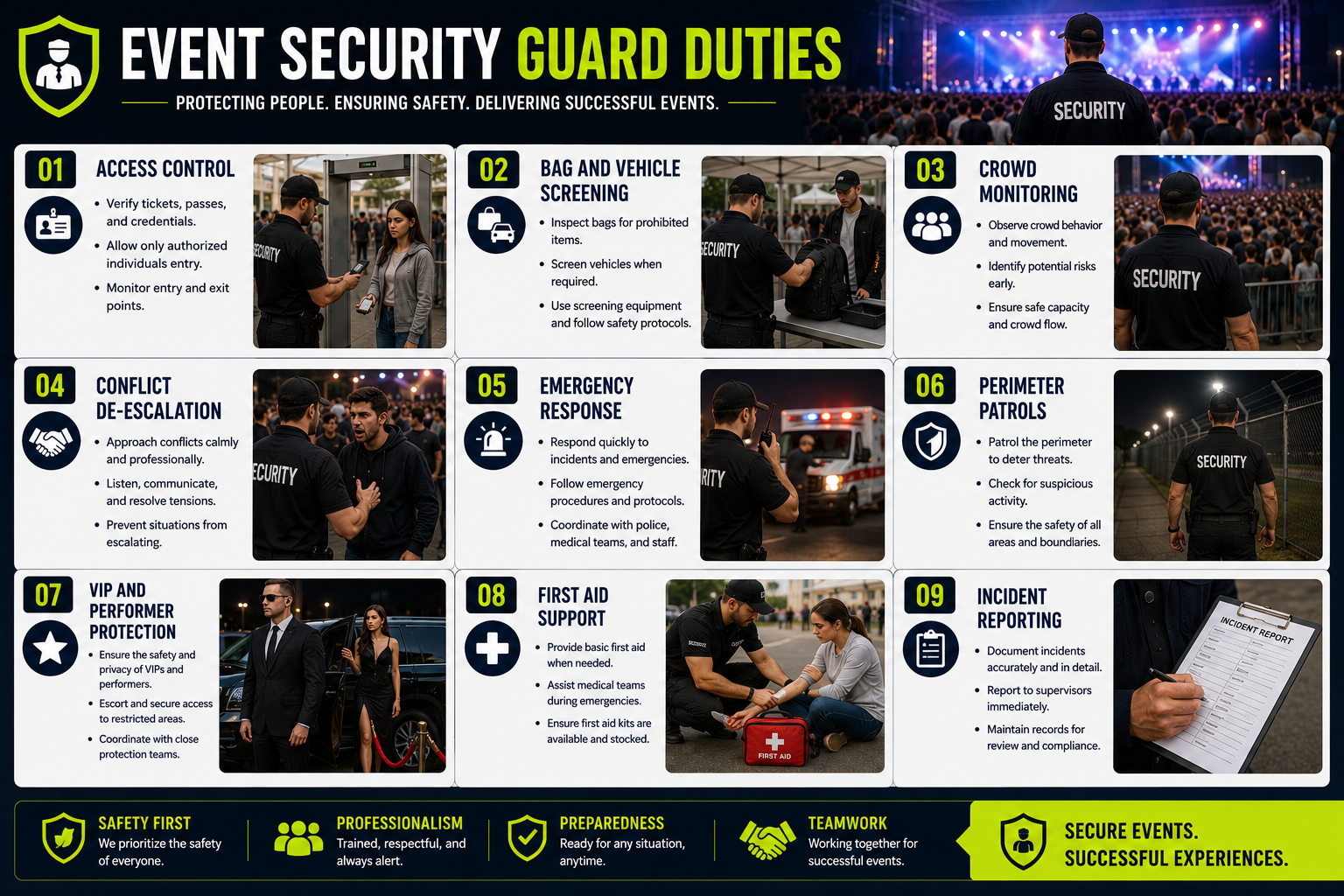
Event security guard duties centre on prevention, control, and response tasks that maintain safety and organisation throughout the gathering. These responsibilities include access control through ticket checking, credential verification, screening procedures, and management of entry points. Guards conduct bag inspections, pat downs where authorised, and operate metal detectors or other screening equipment to prevent prohibited items from entering the venue.

Crowd and queue management represents another core responsibility, requiring guards to facilitate safe movement, prevent overcrowding, and manage exits during high-traffic periods. Security personnel patrol designated areas, monitor perimeters, and maintain presence in high-risk zones to deter theft, disruption, or unauthorised access to restricted areas such as backstage zones, VIP sections, and staff-only spaces. Guards also control access to these restricted zones, verifying credentials and escorting authorised individuals when necessary.

Conflict de-escalation forms a critical competency, with guards trained to intervene calmly when tensions arise between attendees. When situations require additional support, security personnel coordinate with event management, medical teams, and local law enforcement according to established communication protocols. Every incident is documented through detailed reporting, which supports accountability and informs improvements to future security planning.

What Do Event Security Guards Do at Entry and Exit Points?

Security guards stationed at entry points perform ticket verification, ID checks, and bag inspections to ensure only authorised individuals enter the venue. This process involves checking tickets against guest lists, verifying identification documents for age-restricted events, and screening bags for prohibited items. Guards operate security equipment such as metal detectors and RFID scanners while maintaining courteous interactions with guests to set a positive tone for the event experience.

At exit points, security personnel manage crowd flow during dispersal, prevent re-entry without proper credentials, and ensure emergency exits remain clear and functional throughout the event. Guards monitor for individuals attempting to remove property or equipment without authorisation. Exit management becomes particularly important during emergency evacuation scenarios, where security teams direct crowds toward designated safe routes while preventing dangerous bottlenecks.

How Do Event Security Guards Enforce House Rules and Conditions of Entry?

Security guards enforce house rules by clearly communicating conditions of entry, monitoring compliance throughout the venue, and taking appropriate action when violations occur. Enforcement begins at entry points where guards inform attendees of prohibited items, behaviour expectations, and venue policies. This proactive communication reduces violations by ensuring guests understand boundaries before entering.

When rule violations occur, guards approach individuals calmly and professionally, explaining the specific rule being violated and requesting compliance. Trained personnel use de-escalation techniques to resolve situations without confrontation when possible. For persistent violations or serious breaches, guards follow escalation procedures that may involve issuing warnings, relocating individuals, or coordinating removal from the venue with supervisor approval. All enforcement actions are documented to maintain records of incidents and responses.

How Do Event Security Guards Handle Suspicious Behaviour and Disorder?

Security guards detect suspicious behaviour through continuous observation and pattern recognition, watching for individuals who appear nervous, aggressive, or out of place relative to the event context. Guards report observations through radio communication channels, allowing supervisors to coordinate response and dispatch additional personnel if warranted. Early detection enables intervention before suspicious behaviour escalates into actual incidents.

When disorder emerges, guards prioritise bystander safety while working to contain the situation. Response follows established incident protocols: assess the threat level, request appropriate support, attempt de-escalation, and implement physical intervention only when necessary to prevent harm. Guards coordinate with medical personnel for injuries and with law enforcement for criminal matters. Prompt, professional response to disorder maintains overall event safety and demonstrates security effectiveness to other attendees.

How Does Crowd Control and Attendee Management Work at Events?

Crowd control and attendee management operate as planned flow systems designed to keep people moving safely while preventing congestion, crushing, or panic situations. Effective crowd management requires layout planning that establishes clear entry and exit routes, positions barriers strategically, creates lanes for foot traffic, and deploys signage that guides attendees intuitively. Security teams position guards at gates, bottlenecks, high-density zones, and exits where crowd pressure tends to concentrate.

Active monitoring enables guards to watch crowd density, detect behaviour changes, and identify queue buildup before problems develop. Security personnel manage queues and waiting areas, provide clear directions to attendees, and prevent overcrowding near stages, narrow passages, or other pinch points. Communication via radios allows guards to share real-time updates across the venue, enabling supervisors to redirect resources and adjust crowd flow as conditions change throughout the event.

The chain of command and defined escalation procedures ensure quick decisions when crowd situations require intervention. Guards use calm communication and de-escalation techniques to stop small issues from growing into larger problems. Coordination between security posts enables controlled entry during peak arrival periods and managed dispersal at event conclusion, maintaining safety from the first guest arrival through final venue clearance.

How Is Queue Management Planned for Safe Entry and Exit?

Queue management planning begins with analysing expected attendance patterns, identifying peak arrival times, and calculating throughput capacity at each entry point. Security planners position barriers to create defined queue lanes that prevent crowding and allow orderly processing. Multiple entry points distribute incoming crowds, reducing pressure on any single location while maintaining consistent security screening standards across all access points.

For exits, planners identify primary dispersal routes, establish secondary alternatives for peak periods, and ensure emergency exits remain accessible but secured against unauthorised entry. Queue management personnel receive specific training on directing crowd flow, communicating wait times, and recognising signs of crowd frustration that might precede problems. Real-time monitoring allows supervisors to open additional lanes or redirect flow when queue lengths exceed acceptable thresholds.

What Are Safe Crowd Density and Flow Principles at Events?

Safe crowd density principles establish maximum occupancy limits for different venue areas based on available space, exit capacity, and emergency evacuation requirements. Industry guidelines from organisations such as Live Performance Australia recommend specific density thresholds measured in persons per square metre, with lower densities required for standing events than seated configurations. Security teams monitor density visually and can use technology such as people-counting systems to track occupancy in real time.

Flow principles ensure continuous movement through transition zones, preventing static crowds from forming in locations where compression could occur. Guards maintain clear corridors for circulation, discourage standing in thoroughfares, and actively disperse crowds that begin clustering in inappropriate areas. When flow rates slow below acceptable levels, security teams implement queue holding at upstream points to prevent downstream congestion while the bottleneck clears.

How Do Security Guards Support Emergency Evacuation and Medical Response?

Security guards support emergency evacuation by guiding attendees toward designated exit routes, preventing dangerous crowd behaviour, and maintaining clear emergency access paths for first responders. Guards receive training on evacuation procedures specific to each venue, including primary and alternative routes, assembly points, and communication protocols for coordinating with emergency services. During evacuations, guards take positions at key decision points to direct flow and prevent crowds from moving toward hazards.

Medical response support involves identifying individuals requiring assistance, creating clear paths for medical personnel, and providing initial aid when trained to do so. Guards carry first aid training that enables them to stabilise situations until professional medical help arrives. Communication with on-site medical teams ensures rapid response to injuries, while coordination with external emergency services facilitates ambulance access and hospital transport when required. Post-incident, guards document medical events for reporting and review purposes.

What Are the Key Components of an Event Security Plan and Risk Assessment?

An event security plan and risk assessment constitute a structured planning system that identifies event-specific risks and establishes clear controls for safety and order. Key components begin with event profiling, which examines the event type, expected attendance, audience demographics, timing, alcohol service, VIP presence, and other factors that influence risk levels. Site and venue assessment follows, documenting entry and exit points, identifying bottlenecks, mapping restricted zones, evaluating lighting conditions, and plotting emergency routes.

Threat and risk rating processes identify potential hazards, rate their likelihood and impact, establish control measures, and define monitoring approaches for each identified risk. The plan then specifies staffing levels and role assignments, covering supervisors, entry teams, patrol personnel, and crowd controllers positioned throughout the venue. Access control procedures detail ticket verification protocols, screening requirements, and zone-specific permission levels.

Crowd flow management sections address queue configurations, barrier placements, signage locations, and controls for high-density zones. Incident and emergency response procedures outline medical response protocols, evacuation triggers and routes, escalation steps, and liaison arrangements with venue management and police. Communication structure defines the chain of command, radio channel assignments, and reporting requirements. Documentation standards cover incident logging and post-event debriefing, while compliance sections address venue rules, permit conditions, and duty of care obligations.

What Are the Typical Risks at Concerts, Festivals and Sports Events?

Concerts present risks including crowd crushing near stages, sound system failures creating panic, drug and alcohol intoxication, and conflicts between attendees with differing expectations. Large music events may attract individuals seeking to exploit crowded conditions for theft or assault. Stage diving and mosh pit activities create injury risks that require dedicated security presence in front-of-stage areas.

Festivals combine concert risks with additional challenges from extended duration, multiple stages, camping accommodations, and remote locations that complicate emergency response. Weather events can transform festival sites rapidly, creating slip hazards, flooding risks, and shelter concerns. The extended timeframe increases fatigue for both attendees and security personnel, requiring rotation schedules that maintain alertness throughout multi-day events.

Sports events generate risks from rival supporter conflicts, alcohol consumption, projectile throwing, pitch invasions, and post-match confrontations. High-profile matches attract larger crowds and more intense emotions, requiring enhanced security presence and segregation measures. Sports venues often have complex traffic management requirements for parking and public transport access that create additional security considerations beyond the venue itself.

How Is a Site Walk-Through and Vulnerability Check Performed?

Site walk-throughs begin with obtaining venue floor plans and conducting physical inspection of all areas relevant to event security. Security coordinators examine entry points, exit routes, emergency access paths, and restricted zones while noting conditions that differ from documentation. Vulnerability checks assess fence lines, perimeter barriers, lighting coverage, CCTV camera positions, and potential hiding spots or blind areas that could compromise security.

Walk-through teams evaluate crowd flow paths, measuring corridor widths, identifying bottlenecks, and assessing capacity constraints at transition points. Inspectors check that emergency equipment such as fire extinguishers, first aid stations, and evacuation signage are present and functional. Communication coverage is tested throughout the venue to identify dead zones where radio contact might fail. Findings from the walk-through inform adjustments to the security plan, additional equipment requirements, and staffing position refinements before event day.

How Are Staffing Levels and Guard Positions Decided?

Staffing levels derive from risk assessment findings, venue characteristics, expected attendance, and regulatory requirements that may specify minimum security ratios. Industry benchmarks suggest baseline ratios such as one security guard per 100 attendees for low-risk events, with higher ratios for elevated risk profiles. Specific positions are determined by venue layout, with guards assigned to entry points, exit routes, high-density zones, restricted areas, and mobile patrol routes that provide coverage across the entire site.

Position assignments consider sight lines, communication coverage, and response time requirements. Guards at critical posts such as main entries and stage barriers remain stationary, while patrol personnel cover larger areas with scheduled routes that ensure regular presence in all zones. Supervisory positions provide command structure, with senior security personnel positioned at operations centres where they can monitor CCTV feeds, receive radio reports, and coordinate responses across the security team.

How Do Event Security Monitoring, Communication and Incident Response Work in Practice?

Event security operates through integrated monitoring, clear communication channels, and rapid escalation systems that enable coordinated response. Guards monitor the event through patrols, fixed posts, entry point observations, and high-risk zone surveillance, watching for crowd density changes, emerging conflicts, unauthorised access attempts, and safety hazards. CCTV systems provide additional coverage, with operators scanning feeds for situations that ground-level personnel might not observe.

Communication runs through a defined chain of command using radio channels, where staff share concise updates, request support, and escalate issues to supervisors for decisions. Standardised reporting formats ensure critical information transfers clearly without confusion. Radio discipline maintains channel availability for urgent communications while routine updates follow scheduled check-in protocols.

Incident response follows pre-established procedures: contain the situation, attempt de-escalation where appropriate, protect bystanders from harm, coordinate with event management and emergency services when needed, and restore normal operations once the incident resolves. Every incident is logged with time, location, description, actions taken, and outcomes. Post-event debriefing reviews incident reports to identify patterns, evaluate response effectiveness, and capture improvements for future security planning.

What Is an Event Security Audit and Why Does It Matter for Organisers and Venues?

An event security audit is a structured review of security arrangements that confirms risks are identified and controls function effectively across people safety, access control, crowd flow, venue protection, and emergency readiness. Audits examine risk assessment quality, staffing coverage, entry screening procedures, restricted zone control, communication systems, escalation routes, incident logging practices, and compliance with venue rules and duty of care obligations.

Security audits matter because they help organisers and venues identify gaps before incidents occur, reducing safety risks and liability exposure. Proactive auditing protects reputation by demonstrating commitment to attendee welfare and professional event management. Audits create documentation that supports accountability, showing regulators, insurers, and stakeholders that the event was managed responsibly according to established standards.

Regular auditing also drives continuous improvement by identifying weaknesses in current procedures and recommending enhancements based on industry best practices. Venues that conduct security audits before each event develop institutional knowledge that improves efficiency and effectiveness over time. For organisers using external security providers, audits provide independent verification that contracted services meet specified requirements.

What Is Included in an Event Security Audit Checklist?

Event security audit checklists cover pre-event planning elements including risk assessment documentation, security plan completeness, staffing level adequacy, and training verification for assigned personnel. Checklists examine access control arrangements such as ticket verification procedures, screening equipment functionality, credential systems for restricted zones, and entry point capacity relative to expected attendance.

Operational elements include communication system testing, radio coverage verification, chain of command clarity, and escalation procedure documentation. Emergency preparedness items cover evacuation route marking, emergency exit functionality, first aid resource availability, and coordination arrangements with emergency services. Venue-specific items address CCTV system operation, lighting adequacy, barrier placement, and signage visibility. Post-event sections verify incident reporting procedures, debrief scheduling, and documentation retention practices.

How Are Incidents, Near Misses and Lessons Learned Recorded?

Incidents are recorded through standardised reporting forms that capture essential details: time, location, individuals involved, description of what occurred, actions taken by security personnel, outcomes, and any follow-up required. Reports are completed as soon as practical after incidents while details remain fresh, then reviewed by supervisors who may add context or corrective guidance. Serious incidents trigger immediate notification to event management and may require coordination with police or medical services for their own documentation.

Near misses represent situations where incidents almost occurred but were prevented or avoided through intervention or circumstance. Recording near misses provides valuable learning opportunities without waiting for actual harm to occur. Lessons learned sessions occur during post-event debriefings, where security teams review what worked effectively, what challenges arose, and what should be changed for future events. Documented lessons feed back into security planning processes, creating continuous improvement cycles that enhance performance over time.

How Should Event Security Be Managed Before, During and After the Event?

Event security management operates as a three-phase system maintaining control from initial planning through post-event closure. Before the event, management activities include conducting site assessments, completing risk assessments, developing written security plans, determining staffing requirements, assigning roles, mapping zones for entry points and restricted areas, and establishing communication protocols with clear escalation rules. Pre-event briefings ensure all personnel understand their assignments and procedures.

During the event, management focuses on live monitoring through fixed posts and mobile patrols, maintaining access control at all entry points, managing crowd and queue flow, coordinating responses via radio under the established chain of command, and ensuring consistent incident response with proper documentation. Supervisors maintain situational awareness through CCTV monitoring and regular check-ins from field personnel, adjusting resource deployment as conditions evolve.

After the event, security management ensures safe crowd dispersal and controlled exits, completes all incident reports, secures the venue and any remaining assets, and conducts debriefing sessions with the security team. Debriefs capture observations, evaluate response effectiveness, identify lessons learned, and generate recommendations for future improvements. Final reports provide organisers with comprehensive documentation of security performance and outcomes.

How Can Organisers Continuously Improve Event Security from One Event to the Next?

Continuous improvement begins with systematic debriefing after each event, gathering input from security personnel at all levels about what worked effectively and what presented challenges. Organisers should review incident reports to identify patterns, near misses to recognise emerging risks, and attendee feedback to understand security perception from the guest perspective. This information feeds directly into planning for subsequent events.

Improvement also comes from staying current with industry developments, including new technologies, updated guidelines from organisations such as ASIS International, and lessons learned from incidents at other events. Training programmes should evolve based on identified skill gaps and changing threat profiles. Regular security audits conducted by independent assessors provide objective evaluation that internal reviews might miss. Documentation of improvements over multiple events creates institutional knowledge that compounds security effectiveness over time.

What KPIs Help Measure Event Security Performance and Visitor Satisfaction?

Key performance indicators for event security include incident count and severity levels, response times from detection to resolution, entry processing rates and queue lengths, ejection numbers and reasons, and near-miss reports that indicate potential issues prevented. Lower incident rates suggest effective deterrence and early intervention, while faster response times demonstrate operational efficiency and coordination.

Visitor satisfaction metrics capture security perception through post-event surveys asking about feelings of safety, security staff professionalism, entry experience quality, and overall confidence in event management. Complaint volumes related to security interactions indicate areas requiring improvement. Combining operational KPIs with satisfaction measures provides balanced assessment that values both objective security outcomes and subjective attendee experience, guiding improvements that enhance both safety and enjoyment.

Frequently Asked Questions About Event Security

No, not all events require professional security guards. Small private gatherings with known attendees in controlled environments may not need formal security arrangements. However, public events, gatherings serving alcohol, events with more than 100 attendees, and any event where crowd management presents challenges benefit significantly from professional security presence. Regulatory requirements in many jurisdictions mandate licensed security personnel for events exceeding certain attendance thresholds or serving alcohol.

Crowd control in event security means the strategies, techniques, and physical measures used to manage the movement, density, and behaviour of large groups of people. Crowd control encompasses queue management at entry points, flow direction through the venue, density monitoring in high-traffic areas, dispersal procedures at event conclusion, and intervention techniques when crowds become agitated or dangerous. Effective crowd control maintains safety by preventing crushing, stampedes, and panic while enabling attendees to move comfortably throughout the event space.

Events benefiting most from professional security services include concerts and music festivals with large standing crowds, sporting events where rival supporters gather, corporate functions with VIP attendees requiring protection, nightclub and licensed venue events involving alcohol service, political rallies or public demonstrations with potential for conflict, conferences handling sensitive information or high-value exhibits, and community events in public spaces where crowd management presents logistical challenges. Events featuring celebrities, controversial topics, or high-value transactions carry elevated risk profiles that professional security effectively addresses.

Indoor event security operates within defined spaces with controlled entry points, established emergency exits, existing CCTV infrastructure, and climate-controlled environments. Outdoor event security faces additional challenges including larger perimeters requiring more extensive fencing or barriers, weather impacts on both attendees and security operations, terrain variations affecting patrol routes and visibility, and coordination with external parties for traffic management and parking. Outdoor events typically require higher staffing ratios due to expanded coverage areas and may need specialised equipment such as portable lighting, weather shelters for security posts, and extended-range communication systems.

Event organisers prepare venues for security operations by providing accurate floor plans and site documentation to security providers during planning phases. Organisers should ensure adequate lighting at entry points, exit routes, and perimeter areas. Clear signage indicating prohibited items, conditions of entry, and emergency exits helps security personnel and attendees alike. Venue preparation includes testing communication equipment coverage throughout the space, verifying CCTV camera functionality, confirming emergency exit operability, and establishing dedicated spaces for security briefings and incident management. Coordination meetings between venue management, event organisers, and security providers before event day ensure all parties understand arrangements and responsibilities.

Organisers should select event security providers by verifying licensing credentials, insurance coverage, and industry certifications held by the company and its personnel. Reviewing experience with similar event types provides insight into relevant expertise. Requesting references from previous clients and checking reviews helps assess reliability and professionalism. Evaluation should include examining the provider’s risk assessment approach, training programmes, communication systems, and incident reporting procedures. Meeting with the proposed event supervisor before contracting confirms competency and establishes working relationships. Price comparisons should consider service quality and staffing ratios rather than focusing solely on lowest cost.

Professional event security guards receive training covering security licensing requirements, legal powers and limitations, conflict de-escalation techniques, physical intervention methods, first aid certification, emergency response procedures, and communication protocols. Specialised event security training addresses crowd management principles, venue-specific procedures, access control systems, and coordination with emergency services. Guards working particular event types may receive additional training relevant to those environments, such as alcohol service management for licensed events or VIP protection techniques for high-profile functions. Ongoing professional development through organisations such as ASIS International maintains current knowledge of industry standards and emerging best practices.